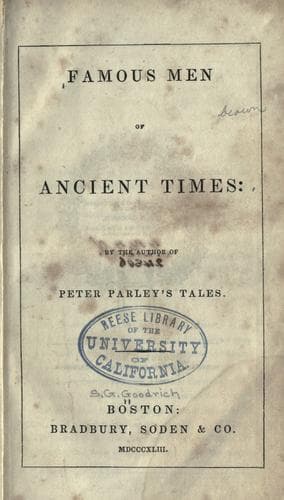
Famous Men of Ancient TimesGoodrich, Samuel G. (Samuel Griswold)
History
Famous Men of Ancient Times
Goodrich, Samuel G. (Samuel Griswold)
Biography -- Juvenile literature; Men -- Biography -- Juvenile literature
In the year 342 B. C., Aristotle was invited by Philip to take charge
of the education of his son, Alexander, then fourteen years old.
This charge was accepted, and Alexander was under his care three or
four years. The particulars of his method of instruction are not
known to us; but when we see the greatness of mind that Alexander
displayed in the first years of his reign,—his command of his passions
till flattery had corrupted him, and his regard for the arts and
sciences,—we cannot but think that his education was judiciously
conducted. It may be objected that Aristotle neglected to guard his
pupil against ambition and the love of conquest; but it must be
recollected that he was a Greek, and of course a natural enemy to the
Persian kings; his hatred had been deepened by the fate of his friend
Hermeias; and, finally, the conquest of Persia had, for a long time,
been the wish of all Greece. It was, therefore, natural that Aristotle
should exert all his talents to form his pupil with the disposition and
qualifications necessary for the accomplishment of this object.
Both father and son sought to show their gratitude for the services of
such a teacher. Philip rebuilt Stagira, and established a school there
for Aristotle. The Stagirites, in gratitude for this service, appointed
a yearly festival, called _Aristotelia_. The philosopher continued at
Alexander’s court a year after his accession to the throne, and is
said to have then repaired to Athens. Ammonius, the Eclectic, says
that he followed his pupil in a part of his campaigns; and this seems
very probable; for it is hardly possible that so many animals as the
philosopher describes could have been sent to Athens, or that he could
have given so accurate a description of them without having personally
dissected and examined them. We may conjecture that he accompanied
Alexander as far as Egypt, and returned to Athens about 331 B. C.,
provided with the materials for his excellent History of Animals.
Aristotle, after parting with Alexander, returned to Athens, where he
resolved to open a school, and chose a house, which, from its vicinity
to the temple of Apollo Lyceus, was called the _Lyceum_. Attached to
this building was a garden, with walks, in Greek _peripatoi_, where
Aristotle used to deliver his instructions to his disciples; whence his
school obtained the name of _peripatetic_. It appears that his habit
was to give one lecture in the early part of the day on the abstruser
parts of his philosophy, to his more advanced scholars, which was
called the _morning walk_, and lasted till the hour when people dressed
and anointed themselves; and another lecture, called the _evening
walk_, on more popular subjects, to a less select class.
Public-domain text, read in full here on John Shaqi.
Reviews
Reviews
No reviews yet
Be the first to share your thoughts on this work.
Elsewhere in the archive
Join the Discussion
Join the discussion
Sign in to leave a comment or review.
Sign InorCreate an account