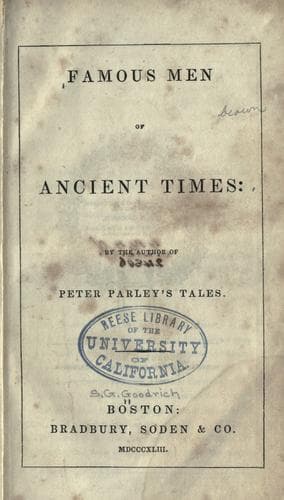
Famous Men of Ancient TimesGoodrich, Samuel G. (Samuel Griswold)
History
Famous Men of Ancient Times
Goodrich, Samuel G. (Samuel Griswold)
Biography -- Juvenile literature; Men -- Biography -- Juvenile literature
The characteristic of Aristotle’s philosophy, as compared with
that of Plato, is, that while the latter gave free scope to his
imagination, and, by his doctrine that we have ideas independent of
the objects which they represent, opened a wide door to the dreams of
mysticism—the latter was a close and strict observer of both mental
and physical phenomena, avoiding all the seductions of the fancy,
and following a severe, methodical, and strictly scientific course
of inquiry, founded on data ascertained by experience. The truly
philosophical character of his mind, and his calm and singularly
dispassionate manner of writing, are not more remarkable than the
vast extent both of his reading and of his original researches. His
writings appear to have embraced nearly the whole circle of the
theoretical and practical knowledge of his time, comprising treatises
on logical, metaphysical, rhetorical, poetical, ethical, political,
economical, physical, mechanical, and medical science. He likewise
wrote on some parts of the mathematics; and, besides a collection of
the constitutions of all the states known in his age, both Grecian and
barbarian he made chronological compilations relating to the political
and dramatic history of Greece.
His works, however, though embracing so large an extent of subjects,
were not a mere encyclopædia, or digest of existing knowledge; some
of the sciences which he treated of were created by himself, and
the others were enriched by fresh inquiries, and methodized by his
systematic diligence. To the former belong his works on analytics and
dialectics, or, as it is now called, logic; to the invention of which
science he distinctly lays claim, stating that “before his time nothing
whatever had been done in it.” Nearly the same remark applies to his
metaphysical treatise. “But of all the sciences,” says Cuvier, “there
is none which owes more to Aristotle, than the natural history of
animals. Not only was he acquainted with a great number of species, but
he has studied and described them on a luminous and comprehensive plan,
to which, perhaps, none of his successors has approached; classing the
facts not according to the species, but according to the organs and
functions, the only method of establishing comparative results. Thus it
may be said that he is not only the most ancient author of comparative
anatomy, whose works have come down to us, but that he is one of those
who have treated this branch of natural history with the most genius,
and that he best deserves to be taken for a model. The principal
divisions which naturalists still follow in the animal kingdom,
are due to Aristotle; and he had already pointed out several which
have recently been again adopted, after having once been improperly
abandoned. If the foundations of these great labors are examined,
it will be seen that they all rest on the same method. Everywhere
Aristotle observes the facts with attention; he compares them with
Public-domain text, read in full here on John Shaqi.
Reviews
Reviews
No reviews yet
Be the first to share your thoughts on this work.
Elsewhere in the archive
Join the Discussion
Join the discussion
Sign in to leave a comment or review.
Sign InorCreate an account