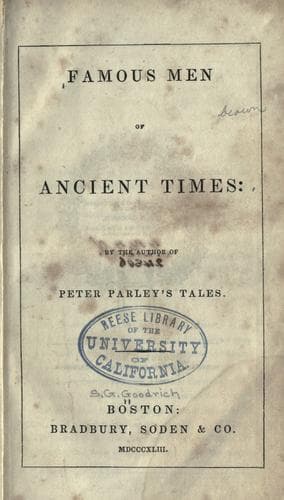
Famous Men of Ancient TimesGoodrich, Samuel G. (Samuel Griswold)
History
Famous Men of Ancient Times
Goodrich, Samuel G. (Samuel Griswold)
Biography -- Juvenile literature; Men -- Biography -- Juvenile literature
Aristotle had, at this time, reached the most prosperous period of his
life. The founder and leader of the principal school of Greece, and
the undisputed head of Grecian philosophy, surrounded by his numerous
disciples and admirers, protected by the conqueror of Asia, and by him
furnished with the means of following his favorite pursuits, and of
gratifying his universal spirit of inquiry, he had, probably, little
to desire in order to fill up the measure of a philosopher’s ambition.
But he did not continue to enjoy the favor of Alexander till the end.
Callisthenes, by his free-spoken censures and uncourtly habits, had
offended his master, and had been executed, on a charge of having
conspired with some Macedonians to take away his life; and the king’s
wrath appears to have extended to his kinsman, Aristotle, as being the
person who had originally recommended him. It is not, however, probable
that this circumstance caused any active enmity between the royal pupil
and his master; even if we did not know that Alexander died a natural
death, there would be no reason for listening to the absurd calumny
that Aristotle was concerned in poisoning him. Aristotle indeed appears
to have been considered, to the last, as a partisan of Alexander, and
an opponent of the democratic interest.
When the anti-Macedonian party obtained the superiority at Athens in
consequence of Alexander’s death, an accusation against Aristotle was
immediately prepared, and the pretext selected, was, as in the case of
Socrates, _impiety_, or _blasphemy_. He was charged by Eurymedon, the
priest, and a man named Demophilus, probably a leader of the popular
party, with paying divine honors to Hermeias, and perhaps with teaching
certain irreligious doctrines. In order to escape this danger, and
to prevent the Athenians, as he said, in allusion to the death of
Socrates, from “sinning twice against philosophy,” he quitted Athens
in the beginning of the year 322 B. C., and took refuge at Chalcis,
in Euboea, an island then under the Macedonian influence—leaving
Theophrastus his successor in the Lyceum. There he died, of a
disease of the stomach, in the autumn of the same year, being in the
sixty-third year of his age. His frame is said to have been slender and
weakly, and his health had given way in the latter part of his life,
having probably been impaired by his unwearied studies and the intense
application of his mind. The story of his having drowned himself in the
Euripus of Euboea, is fabulous.
Public-domain text, read in full here on John Shaqi.
Reviews
Reviews
No reviews yet
Be the first to share your thoughts on this work.
Elsewhere in the archive
Join the Discussion
Join the discussion
Sign in to leave a comment or review.
Sign InorCreate an account