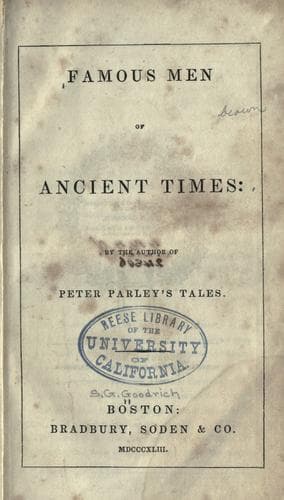
Famous Men of Ancient TimesGoodrich, Samuel G. (Samuel Griswold)
History
Famous Men of Ancient Times
Goodrich, Samuel G. (Samuel Griswold)
Biography -- Juvenile literature; Men -- Biography -- Juvenile literature
Of all the philosophers of antiquity, Aristotle has produced the most
lasting and extensive effect on mankind. His philosophical works, many
centuries after his death, obtained a prodigious influence, not only in
Europe, but even in Asia; they were translated into Arabic, and from
thence an abstract of his logical system passed into the language of
Persia. In Europe they acquired an immense ascendency in the middle
ages, and were considered as an authority without appeal, and only
second to that of Scripture; we are even informed that in a part of
Germany his ethics were read in the churches on Sunday, in the place
of the Gospels. Parts of his philosophy, which are the most worthless,
as his Physics, were much cultivated; and his logical writings were,
in many cases, abused so as to lead to vain subtleties, and captious
contests about words. The connection between some of his tenets and the
Roman Catholic theology, tended much to uphold his authority, which
the Reformation lowered in a corresponding degree. His doctrines were
in general strongly opposed by the early reformers. In 1518 Luther
sustained a thesis at Heidelberg, affirming that “he who wishes to
philosophize in Aristotle, must be first stultified in Christ.” Luther,
however, gave way afterwards, and did not oppose Aristotle, as to human
learning. Melanchthon, who was one of the mildest of the reformers, was
a great supporter of Aristotle. Many of his doctrines were in the same
century zealously attacked by the French philosopher, Pierre Ramus.
Bacon, afterwards, with others of his followers, added the weight of
their arguments and authority against him. Aristotle’s philosophy
accordingly fell into undeserved neglect during the latter part of the
seventeenth, and the whole of the eighteenth century. Of late, however,
the true worth of his writings has been more fully appreciated, and the
study of his best treatises has much revived.
The most valuable of Aristotle’s lost works, and indeed the most
valuable of all the lost works of Greek prose, is his collection of One
Hundred and Fifty-eight Constitutions, both of Grecian and Barbarian
States, the Democratic, Oligarchical, Aristocratical, and Tyrannical,
being treated separately, containing an account of the manners,
customs, and institutions of each country. The loss of his works on
Colonies, on Nobility, and on Royal Government; of his Chronological
Collections, and of his Epistles to Philip, Alexander, Antipater, and
others, is also much to be regretted. He likewise revised a copy of
the Iliad, which Alexander carried with him during his campaigns, in a
precious casket; hence this recension, called the _casket copy_, passed
into the Alexandrine library, and was used by the Alexandrine critics.
His entire works, according to Diogenes Laertius, occupied in the Greek
manuscripts 445,270 lines.
[Illustration]
[Illustration]
DEMOSTHENES.
Public-domain text, read in full here on John Shaqi.
Reviews
Reviews
No reviews yet
Be the first to share your thoughts on this work.
Elsewhere in the archive
Join the Discussion
Join the discussion
Sign in to leave a comment or review.
Sign InorCreate an account