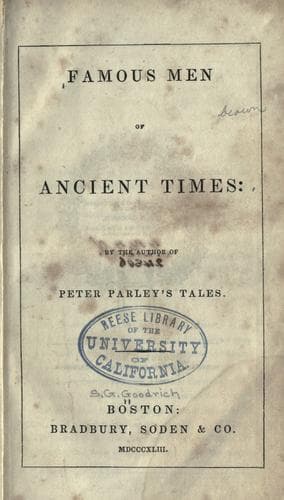
Famous Men of Ancient TimesGoodrich, Samuel G. (Samuel Griswold)
History
Famous Men of Ancient Times
Goodrich, Samuel G. (Samuel Griswold)
Biography -- Juvenile literature; Men -- Biography -- Juvenile literature
This celebrated Grecian orator was born about 384 or 385 years B.
C., at a period when Athens had reached the zenith of her literary,
and had passed that of her political, glory. Juvenal has represented
him slightingly, as the son of a blacksmith—the fact being that the
elder Demosthenes was engaged in various branches of trade, and, among
others, was owner of a sword manufactory. His maternal grandmother was
a Thracian woman—a circumstance noticeable because it enabled his
enemies, in the spirit of ill-will, to taunt him as a barbarian and
hereditary enemy of his country; for the Greeks, in general, regarded
the admixture of other than Greek blood, with the same sort of contempt
and dislike that the whites of America do the taint of African descent.
Being left an orphan when seven years old, Demosthenes fell into the
hands of dishonest guardians, who embezzled a large portion of the
property which his father had bequeathed to him. His constitution
appears to have been delicate, and it may have been on this account
that he did not attend the gymnastic exercises, which formed a large
portion of the education of the youths in Greece; exercises really
important where neither birth nor wealth set aside the obligation to
military service common to all citizens; and where, therefore, skill
in the use of arms, strength, and the power to endure fatigue and
hardship, were essential to the rich as well as to the poor. It may
have been on this account that a nickname expressive of effeminacy
was bestowed on him, which was afterwards interpreted into a proof of
unmanly luxury and vicious habits; indeed, the reproach of wanting
physical strength clung to him through life; and apparently this was
not undeserved. Another nickname that he obtained was that of “Viper.”
In short, the anecdotes which have come down to us, tend pretty
uniformly to show that his private character was harsh and unamiable.
His ambition to excel as an orator is said to have been kindled by
hearing a masterly and much admired speech of Callistratus. For
instruction, he resorted to Isæus, and, as some say, to Isocrates, both
eminent teachers of the art of rhetoric. He had a stimulus to exertion
in the resolution to prosecute his guardians for abuse of their trust;
and having gained the cause, B. C. 364, in the conduct of which he
himself took an active part, recovered, it would seem, a large part of
his property. The orations against Aphobus and Onetor, which appear
among his works, profess to have been delivered in the course of the
suit; but it has been doubted, on internal evidence, whether they were
really composed by him so early in life.
Public-domain text, read in full here on John Shaqi.
Reviews
Reviews
No reviews yet
Be the first to share your thoughts on this work.
Elsewhere in the archive
Join the Discussion
Join the discussion
Sign in to leave a comment or review.
Sign InorCreate an account