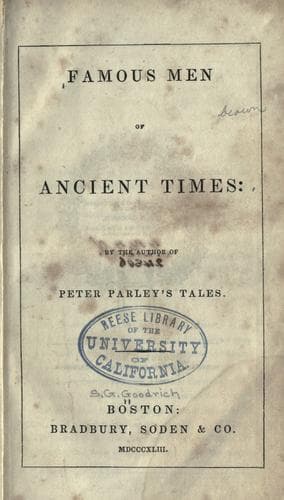
Famous Men of Ancient TimesGoodrich, Samuel G. (Samuel Griswold)
History
Famous Men of Ancient Times
Goodrich, Samuel G. (Samuel Griswold)
Biography -- Juvenile literature; Men -- Biography -- Juvenile literature
Such was the process by which he became confessedly the greatest orator
among the people by whom eloquence was cultivated, as it has never been
since by any nation upon earth. He brought it to its highest state of
perfection, as did Sophocles the tragic drama, by the harmonious union
of excellences which had before only existed apart. The quality in his
writings, which excited the highest admiration of the most intelligent
judges among his countrymen in the later critical age, was the Protean
versatility with which he adapted his style to every theme, so as to
furnish the most perfect examples of every order and kind of eloquence.
Demosthenes, like Pericles, never willingly appeared before his
audience with any but the ripest fruits of his private studies, though
he was quite capable of speaking on the impulse of the moment in a
manner worthy of his reputation. That he continued to the end of his
career to cultivate the art with unabated diligence, and that, even
in the midst of public business, his habits were those of a severe
student, is well known.
The first manifestation of that just jealousy of Philip, the ambitious
king of Macedon, which became the leading principle of his life, was
made 252 B. C., when the orator delivered the first of those celebrated
speeches called Philippics. This word has been naturalized in Latin
and most European languages, as a concise term to signify indignant
invective.
From this time forward, it was the main object of Demosthenes to
inspire and keep alive in the minds of the Athenians a constant
jealousy of Philip’s power and intentions, and to unite the other
states of Greece in confederacy against him. The policy and the
disinterestedness of his conduct have both been questioned; the former,
by those who have judged, from the event, that resistance to the power
of Macedonia was rashly to accelerate a certain and inevitable evil;
the latter, by those, both of his contemporaries and among posterity,
who believe that he received bribes from Persia, as the price of
finding employment in Greece for an enemy, whose ambition threatened
the monarch of the East. With respect to the former, however, it
was at least the most generous policy, and like that of the elder
Athenians in their most illustrious days—not to await the ruin of
their independence submissively, until every means had been tried for
averting it; for the latter, such charges are hard either to be proved
or refuted. The character of Demosthenes certainly does not stand above
the suspicion of pecuniary corruption, but it has not been shown, nor
is it necessary or probable to suppose, that his jealousy of Philip
of Macedon was not, in the first instance, far-sighted and patriotic.
During fourteen years, from 352 to 338, he exhausted every resource of
eloquence and diplomatic skill to check the progress of that aspiring
monarch; and whatever may be thought of his moral worth, none can
Public-domain text, read in full here on John Shaqi.
Reviews
Reviews
No reviews yet
Be the first to share your thoughts on this work.
Elsewhere in the archive
Join the Discussion
Join the discussion
Sign in to leave a comment or review.
Sign InorCreate an account