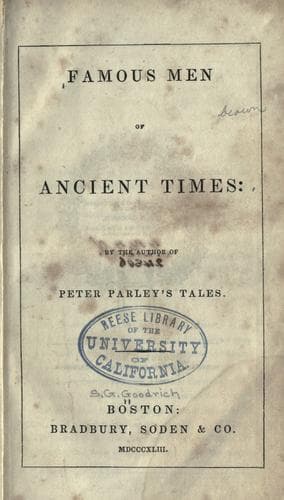
Famous Men of Ancient TimesGoodrich, Samuel G. (Samuel Griswold)
History
Famous Men of Ancient Times
Goodrich, Samuel G. (Samuel Griswold)
Biography -- Juvenile literature; Men -- Biography -- Juvenile literature
undervalue the genius and energy which have made his name illustrious,
and raised a memorial of him far more enduring than sepulchral brass.
In 339 B. C., Philip’s appointment to be general of the Amphictyonic
League gave him a more direct influence than he had yet possessed;
and in the same year, the decisive victory of Cheronea, won over the
combined forces of Thebes, Athens, &c., had made him master of Greece.
Demosthenes served in this engagement, but joined, early in the flight,
with circumstances, according to report, of marked cowardice and
disgrace. He retired for a time from Athens, but the cloud upon his
character was but transient for, shortly after, he was entrusted with
the charge of putting the city in a state of defence, and was appointed
to pronounce the funeral oration over those who had been slain. After
the battle of Cheronea, Philip, contrary to expectation, did not
prosecute hostilities against Athens; on the contrary, he used his
best endeavors to conciliate the affections of the people, but without
success. The party hostile to Macedon soon regained the superiority,
and Demosthenes was proceeding with his usual vigor in the prosecution
of his political schemes, when news arrived of the murder of Philip, in
July, 336.
The daughter of Demosthenes had then lately died; nevertheless, in
violation of national usage, he put off his mourning, and appeared
in public, crowned with flowers and with other tokens of festive
rejoicing. This act, a strong expression of triumph over the fall of
a most dangerous enemy, has been censured with needless asperity;
the accusation of having been privy to the plot for Philip’s murder,
beforehand, founded on his own declaration of the event some time
before intelligence of it came from any other quarter, and the manifest
falsehood as to the source of the information, which he professed to
derive from a divine revelation, involves—if it be judged to be well
founded—a far blacker imputation.
Whether or not it was of his own procuring, the death of Philip was
hailed by Demosthenes as an event most fortunate for Athens, and
favorable to the liberty of Greece. Thinking lightly of the young
successor to the Macedonian crown, he busied himself the more in
stirring up opposition to Alexander, and succeeded in urging Thebes
into that revolt, which ended in the entire destruction of the city,
B. C., 335. This example struck terror into Athens. Alexander demanded
that Demosthenes, with nine others, should be given up into his hands,
as the authors of the battle of Cheronea and of the succeeding troubles
of Greece; but finally contented himself with requiring the banishment
of Charidemus alone.
Public-domain text, read in full here on John Shaqi.
Reviews
Reviews
No reviews yet
Be the first to share your thoughts on this work.
Elsewhere in the archive
Join the Discussion
Join the discussion
Sign in to leave a comment or review.
Sign InorCreate an account