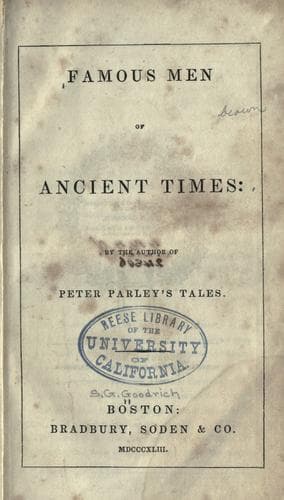
Famous Men of Ancient TimesGoodrich, Samuel G. (Samuel Griswold)
History
Famous Men of Ancient Times
Goodrich, Samuel G. (Samuel Griswold)
Biography -- Juvenile literature; Men -- Biography -- Juvenile literature
If we compare the two greatest orators of antiquity—Cicero and
Demosthenes—it may seem difficult to decide between them. By devoting
his powers almost exclusively to oratory, the latter excelled in
energy, strength, and accuracy; and as a mere artist, was probably the
superior. Cicero, by cultivating a more extended field, was doubtless
far the abler lawyer, statesman and philosopher. Of the value of their
works to mankind, there is no comparison; for those of Cicero are
not only more numerous and diversified, but of more depth, wisdom,
and general application. We must also remark, that while the soul of
Demosthenes appears to have been selfish and mean, that of Cicero ranks
him among the noblest specimens of humanity, whether of ancient or
modern times.
If we compare the speeches of these great men with the efforts of
modern orators, we shall see that the latter greatly surpass them in
range of thought, power of diction and splendor of illustration. The
question then arises, why did the orations of Cicero and Demosthenes
produce such electrical effects upon their auditors? The reason
doubtless was, that they paid the greatest attention to action,
manner and tones of voice—thus operating upon their hearers by
nearly the same powers as the modern opera. There was stage effect in
their manner, and music in their tones, combined with most perfect
elocution—and the application of these arts, carried to the utmost
perfection, was made to the quick Italians or mercurial Athenians.
These suggestions may enable us to understand the fact, that speeches,
which, uttered in the less artful manner of our day, and before our
colder audiences, would fall flat and dead upon the ear, excited the
utmost enthusiasm, in more southern climes, two thousand years ago.
[Illustration]
APELLES
Apelles was a celebrated painter of Cos, a little island in the Egean
Sea. The date of his birth is not known, but he painted many portraits
of Philip, and was still nourishing in the time of Alexander, who
honored him so much that he forbade any other artist to draw his
picture. His chief master was Pamphilius, a famous painter of Macedon.
He was so attentive to his profession, that he never spent a day
without employing his pencil,—whence the proverb of _Nulla die sine
linea_. His most perfect picture was the Venus Anadyomene, which,
however, was not wholly finished when the painter died.
Public-domain text, read in full here on John Shaqi.
Reviews
Reviews
No reviews yet
Be the first to share your thoughts on this work.
Elsewhere in the archive
Join the Discussion
Join the discussion
Sign in to leave a comment or review.
Sign InorCreate an account