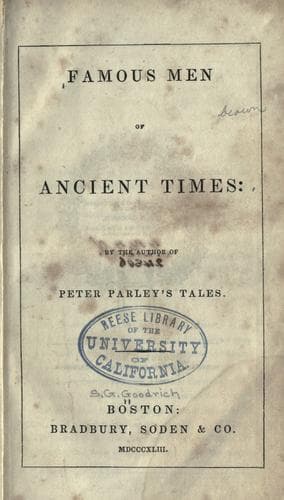
Famous Men of Ancient TimesGoodrich, Samuel G. (Samuel Griswold)
History
Famous Men of Ancient Times
Goodrich, Samuel G. (Samuel Griswold)
Biography -- Juvenile literature; Men -- Biography -- Juvenile literature
A fate similar to that of his rival, overtook Demosthenes himself, a
few years later, B. C. 324. Harpalus, an officer high in rank and favor
under Alexander, having been guilty of malversation to such an extent
that he dared not await discovery, fled to Greece, bringing with him
considerable treasures and a body of mercenary soldiers. He sought the
support of the Athenians; and, as it was said, bribed Demosthenes not
to oppose his wishes. Rumors to that effect got abroad, and though his
proposals were rejected by the assembly, Demosthenes was called to
account, and fined fifty talents, nearly $50,000, as having been bribed
to give false counsel to the people. Being unable to pay the amount
of the fine, it acted as a sentence of banishment, and he retired into
Ægina. Like Cicero, when placed in a similar situation, he displayed
effeminacy of temper, and an unmanly violence of regret, under a
reverse of fortune.
In the following year, however, the death of Alexander restored him
to political importance; for when that event opened once more to the
Athenians the prospect of shaking off the supremacy of Macedonia,
Demosthenes was recalled, with the most flattering marks of public
esteem. He guided the state during the short war waged with Antipater,
the Macedonian viceroy, until the inequality of the contest became
evident, and the Macedonian party regained its ascendency. Demosthenes
then retired to the sanctuary of Calauria, an island sacred to Neptune,
on the coast of Argolis. Sentence of death was passed on him in his
absence. He was pursued to his place of refuge by the emissaries of
Antipater, and being satisfied that the sanctity of the place would not
protect him, he took poison, which, as a last resort, he carried about
his person, concealed in a quill.
Most of the speeches of Demosthenes are short, at least compared with
modern oratory. He rarely spoke extempore, and bestowed an unusual
degree of pains on his composition. That style which is described by
Hume as “rapid harmony, exactly adapted to the sense; vehement reason,
without any appearance of art; disdain, anger, boldness, freedom,
involved in a continued stream of argument”—instead of being, as it
would seem, the effervescence of a powerful, overflowing mind, was the
labored produce of much thought, and careful, long-continued polish.
Public-domain text, read in full here on John Shaqi.
Reviews
Reviews
No reviews yet
Be the first to share your thoughts on this work.
Elsewhere in the archive
Join the Discussion
Join the discussion
Sign in to leave a comment or review.
Sign InorCreate an account