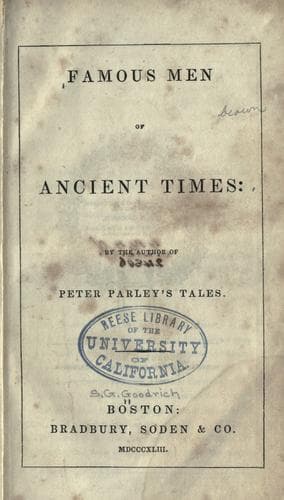
Famous Men of Ancient TimesGoodrich, Samuel G. (Samuel Griswold)
History
Famous Men of Ancient Times
Goodrich, Samuel G. (Samuel Griswold)
Biography -- Juvenile literature; Men -- Biography -- Juvenile literature
By day, he walked through the streets of Athens barefoot, with a long
beard, a stick in his hand, and a bag over his shoulders. He was clad
in a coarse double robe, which served as a coat by day and a coverlet
by night; and he carried a wallet to receive alms. His abode was a
cask in the temple of Cybele. It is said that he sometimes carried a
tub about on his head which occasionally served as his dwelling. In
summer he rolled himself in the burning sand, and in winter clung to
the marble images covered with snow, that he might inure himself to the
extremes of the climate. He bore the scoffs and insults of the people
with the greatest equanimity. Seeing a boy draw water with his hand,
he threw away his wooden goblet, as an unnecessary utensil. He never
spared the follies of men, but openly and loudly inveighed against vice
and corruption, attacking them with keen satire, and biting irony.
The people, and even the higher classes, heard him with pleasure, and
tried their wit upon him. When he made them feel his superiority, they
often had recourse to abuse, by which, however, he was little moved.
He rebuked them for expressions and actions which violated decency and
modesty, and therefore it is not credible that he was guilty of the
excesses with which his enemies reproached him. His rudeness offended
the laws of good breeding, rather than the principles of morality.
On a voyage to the island of Ægina, he fell into the hands of pirates,
who sold him as a slave to Xeniades, a Corinthian. He, however,
emancipated him, and entrusted to him the education of his children. He
attended to the duties of his new employment with the greatest care,
commonly living in summer at Corinth, and in the winter at Athens. It
was at the former place that Alexander found him at the road-side,
basking in the sun; and, astonished at the indifference with which
the ragged beggar regarded him, entered into conversation with him,
and finally gave him permission to ask him a boon. “I ask nothing,”
answered the philosopher, “but that thou wouldst get out of my
sunshine.” Surprised at this proof of content, the king is said to have
exclaimed, “Were I not Alexander, I would be Diogenes.” The following
dialogue, though not given as historical, is designed to represent this
interview.
_Diogenes._ Who calleth?
_Alexander._ Alexander. How happeneth it that you would not come out
of your tub to my palace?
_D._ Because it was as far from my tub to your palace, as from your
palace to my tub.
_A._ What! dost thou owe no reverence to kings?
_D._ No.
_A._ Why so?
_D._ Because they are not gods.
_A._ They are gods of the earth.
_D._ Yes, gods of the earth!
_A._ Plato is not of thy mind.
_D._ I am glad of it.
_A._ Why?
_D._ Because I would have none of Diogenes’ mind but Diogenes.
_A._ If Alexander have anything that can pleasure Diogenes, let me
know, and take it.
Public-domain text, read in full here on John Shaqi.
Reviews
Reviews
No reviews yet
Be the first to share your thoughts on this work.
Elsewhere in the archive
Join the Discussion
Join the discussion
Sign in to leave a comment or review.
Sign InorCreate an account