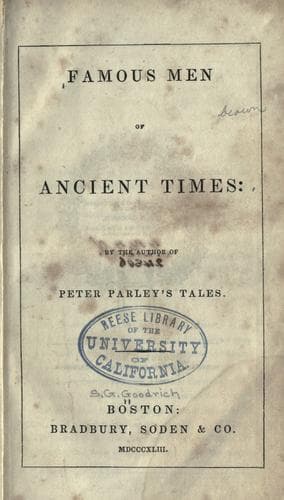
Famous Men of Ancient TimesGoodrich, Samuel G. (Samuel Griswold)
History
Famous Men of Ancient Times
Goodrich, Samuel G. (Samuel Griswold)
Biography -- Juvenile literature; Men -- Biography -- Juvenile literature
_D._ Then take not from me that you cannot give me—the light of the
sun!
_A._ What dost thou want?
_D._ Nothing that you have.
_A._ I have the world at command.
_D._ And I in contempt.
_A._ Thou shalt live no longer than I will.
_D._ But I shall die, whether you will or no.
_A._ How should one learn to be content?
_D._ Unlearn to covet.
_A._ (_to Hephæstion._) Hephæstion, were I not Alexander, I would wish
to be Diogenes.
_H._ He is dogged, but shrewd; he has a sharpness, mixed with a kind
of sweetness; he is full of wit, yet too wayward.
_A._ Diogenes, when I come this way again, I will both see thee and
confer with thee.
_D._ Do.
We are told that the philosopher was seen one day carrying a lantern
through the streets of Athens: on being asked what he was looking
after, he answered, “I am seeking an honest man.” Thinking he had found
among the Spartans the greatest capacity for becoming such men as he
wished, he said, “Men, I have found nowhere, but children, at least,
I have seen in Lacedæmon.” Being asked, “What is the most dangerous
animal?” his answer was, “Among wild animals, the slanderer; among
tame, the flatterer.” He expired 323 B. C., at a great age, and, it
is said, on the same day that Alexander died. When he felt death
approaching, he seated himself on the road leading to Olympia, where he
died with philosophical calmness, in the presence of a great number of
people who were collected around him.
None of the works of Diogenes are extant; in these he maintained the
doctrines of the Cynics. He believed that exercise was of the greatest
importance, and capable of effecting everything. He held that there
were two kinds of exercise,—one of the body, and one of the mind,—and
that one was of little use without the other. By cultivation of the
mind, he did not mean the accumulation of knowledge or science, but a
training which might give it vigor, as exercise endows the body with
health and strength.
[Footnote 11: The Cynics were a sect of philosophers, founded by
Antisthenes, at Athens; they took their name from their disposition to
criticise the lives and actions of others. They were famous for their
contempt of riches, their neglect of dress, and the length of their
beards. They usually slept on the ground.]
[Illustration]
PLATO.
It has been remarked by Coleridge, that all men are born disciples
either of Plato or Aristotle: by which he means that these two great
men are the leaders in the two kinds of philosophy which govern the
thinking world,—the one looking into the soul, as the great well of
truth; the other, studying the outward world, and building up its
system upon facts collected by observation. The truth is doubtless to
be found by compounding the two systems.
Public-domain text, read in full here on John Shaqi.
Reviews
Reviews
No reviews yet
Be the first to share your thoughts on this work.
Elsewhere in the archive
Join the Discussion
Join the discussion
Sign in to leave a comment or review.
Sign InorCreate an account