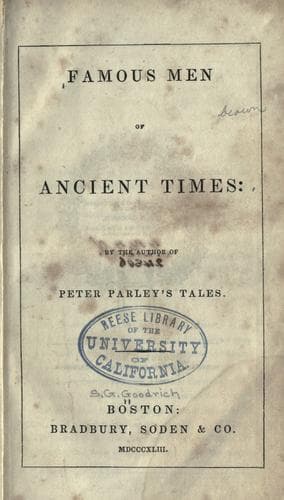
Famous Men of Ancient TimesGoodrich, Samuel G. (Samuel Griswold)
History
Famous Men of Ancient Times
Goodrich, Samuel G. (Samuel Griswold)
Biography -- Juvenile literature; Men -- Biography -- Juvenile literature
The works of Plato are numerous; with the exception of twelve letters,
they are all written in the form of dialogue, in which Socrates is the
principal interlocutor. Thus he always speaks by the mouth of others,
and the philosopher has nowhere made mention of himself, except once
in his dialogue entitled Phædon, and another time in his Apology
for Socrates. His writings were so celebrated, and his opinions so
respected, that he was called divine; and for the elegance, melody, and
sweetness of his expressions, he was distinguished by the appellation
of the Athenian bee. His style, however, though commended and admired
by the most refined critics among the ancients, has not escaped the
censure of some of the moderns. It is obvious that the philosopher
cannot escape ridicule, who supposes that fire is a pyramid tied to
the earth by numbers; that the world is a figure consisting of twelve
pentagons; and who, to prove the metempsychosis and the immortality
of the soul, asserts that the dead are born from the living, and the
living from the dead. The speculative mind of Plato was employed in
examining things divine and human; and he attempted to ascertain and
fix not only the practical doctrines of morals and politics but the
more subtle and abstruse theory of mystical theogony—the origin of
the gods, or divine power. His philosophy was universally received and
adopted in ancient times, and it has not only governed the opinions of
the speculative part of mankind, but it continues still to influence
the reasoning, and to divide the sentiments of the moderns.
In his system of philosophy, he followed the physics of Heraclitus,
the metaphysical opinions of Pythagoras, and the morals of Socrates.
He maintained the existence of two beings—one self-existent, and the
other formed by the hand of a pre-existent, creative god and man. The
world, he maintained, was created by that self-existent cause, from the
rude, undigested mass of matter which had existed from all eternity,
and which had ever been animated by an irregular principle of motion.
The origin of evil could not be traced under the government of a deity,
without admitting a stubborn intractability and wildness congenial
to matter; and from these, consequently, could be demonstrated the
deviations from the laws of nature, and from thence, the extravagant
passions and appetites of men.
Public-domain text, read in full here on John Shaqi.
Reviews
Reviews
No reviews yet
Be the first to share your thoughts on this work.
Elsewhere in the archive
Join the Discussion
Join the discussion
Sign in to leave a comment or review.
Sign InorCreate an account