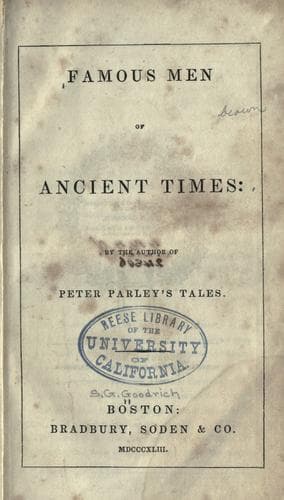
Famous Men of Ancient TimesGoodrich, Samuel G. (Samuel Griswold)
History
Famous Men of Ancient Times
Goodrich, Samuel G. (Samuel Griswold)
Biography -- Juvenile literature; Men -- Biography -- Juvenile literature
When he had finished his travels, Plato retired to the groves of
Academus, in the neighborhood of Athens, and established a school
there; his lectures were soon attended by a crowd of learned, noble,
and illustrious pupils; and the philosopher, by refusing to have a
share in the administration of political affairs, rendered his name
more famous and his school more frequented. During forty years he
presided at the head of the academy, and there he devoted his time to
the instruction of his pupils, and composed those dialogues which have
been the admiration of every succeeding age. His studies, however,
were interrupted for a while, as he felt it proper to comply with the
pressing invitations of Dionysius, of Syracuse, to visit him. The
philosopher earnestly but vainly endeavored to persuade the tyrant to
become the father of his people, and the friend of liberty.
In his dress, Plato was not ostentatious; his manners were elegant, but
modest, simple, and without affectation. The great honors which were
bestowed upon him, were not paid to his appearance, but to his wisdom
and virtue. In attending the Olympian games, he once took lodgings
with a family who were totally strangers to him. He ate and drank
with them, and partook of their innocent pleasures and amusements;
but though he told them his name was Plato, he did not speak of the
employment he pursued at Athens, and never introduced the name of that
great philosopher, whose doctrines he followed, and whose death and
virtues were favorite topics of conversation in every part of Greece.
When he returned to Athens, he was attended by the family which had
so kindly entertained him; and, being familiar with the city, he was
desired to show them the celebrated philosopher whose name he bore.
Their surprise may be imagined, when he told them that he was the Plato
whom they wished to behold.
In his diet he was moderate; and, indeed, to sobriety and temperance in
the use of food, and abstinence from those indulgences which enfeeble
the body and enervate the mind, some have attributed his preservation
during a terrible pestilence which raged in Athens at the beginning
of the Peloponnesian war. Plato was never subject to any long or
lingering indisposition; and, though change of climate had enfeebled a
constitution naturally strong and healthy, the philosopher lived to an
advanced age, and was often heard to say, when his physicians advised
him to leave his residence at Athens, where the air was impregnated by
the pestilence, that he would not advance one single step to gain the
top of Mount Athos, were he assured of attaining the longevity which
the inhabitants of that mountain were said to enjoy. Plato died on his
birth-day, in the eighty-first year of his age, about the year 348 B.
C. His last moments were easy, and without pain; and, according to
some authors, he expired in the midst of an entertainment; but Cicero
tells us that he died while in the act of writing.
Public-domain text, read in full here on John Shaqi.
Reviews
Reviews
No reviews yet
Be the first to share your thoughts on this work.
Elsewhere in the archive
Join the Discussion
Join the discussion
Sign in to leave a comment or review.
Sign InorCreate an account