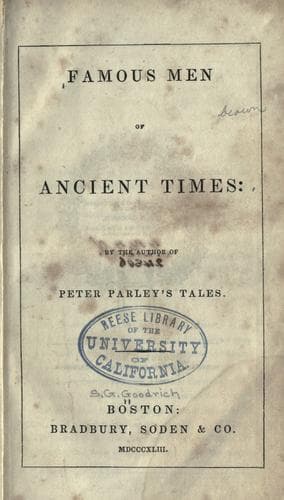
Famous Men of Ancient TimesGoodrich, Samuel G. (Samuel Griswold)
History
Famous Men of Ancient Times
Goodrich, Samuel G. (Samuel Griswold)
Biography -- Juvenile literature; Men -- Biography -- Juvenile literature
The soul is here compared to a chariot, drawn by a pair of winged
steeds, one of which is well-bred and well-trained, and the other quite
the contrary. The quiet horse, the Will, is obedient to the rein, and
strives to draw its wilder yoke-fellow, the Appetite, along with it,
and to induce it to listen to the voice of the charioteer, Reason. But
they have a great deal of trouble with the restive horse, and the whole
object of the journey seems to be lost, if this is permitted to have
its way. In this allegory, it is shown that the object of Reason, in
exacting obedience, is not merely that discipline and subordination
which constitute the virtues of man, but to keep the mind in a state
to rise to the contemplation and enjoyment of great and eternal truths.
In other words, a man must be in a moral state, before he can place
himself in a religious state, so as to enjoy the _summum bonum_, or
greatest good. What, then, is this greatest good? or, in the language
of Plato, its _idea_?—for, with him, _idea_ and _essence_ are
synonymous. This is God—not his image, but his nature, which is the
sovereign good. Thus the greatest happiness of man was placed by Plato
in a mysterious union of the soul with this source of goodness. How
near an approach to Christian communion with God, is this?
However fantastic many of the details of Plato’s system may seem, and
however illusory its whole machinery must appear, when viewed in the
light of modern criticism, one thing is to be observed,—that the
great results of his philosophy are true. He struggled through the
thick mists of his age, and discovered the eternal existence of Deity;
he perceived and established, on grounds not to be controverted, the
immortality of the soul. He placed true happiness where philosophy and
religion place it—in the ascendency of the spirit over the body—the
subjugation of the passions to the dominion of reason and virtue. It
appears that the germs of these great truths had already manifested
themselves in the minds of Pythagoras, Socrates, and others; and Plato
borrowed from them many of his noble ideas. But he systematized what
they had left in a crude state; he gave a more clear and distinct
utterance to what his great master, Socrates, had dimly conceived, and
ineffectually struggled to announce. He reached the highest point, in
the search after divine knowledge which has ever been attained, without
the direct aid of inspiration. In the gradual development of God’s will
to man, he was one of the great instruments. Yet, in reviewing his
works, we see how imperfect was still his knowledge of things divine,
and what fearful shadows would rest upon the world, if Plato were our
only guide. How dark, uncertain, mysterious, would be the ways of
God—the destinies of man—if left where the philosopher left them!
[Illustration]
[Illustration]
SOCRATES.
Public-domain text, read in full here on John Shaqi.
Reviews
Reviews
No reviews yet
Be the first to share your thoughts on this work.
Elsewhere in the archive
Join the Discussion
Join the discussion
Sign in to leave a comment or review.
Sign InorCreate an account