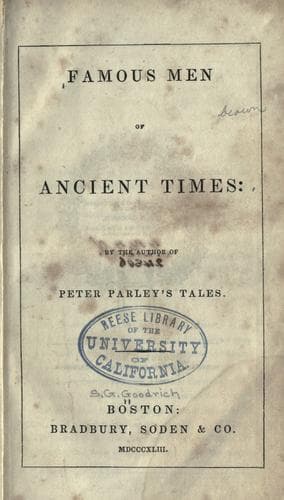
Famous Men of Ancient TimesGoodrich, Samuel G. (Samuel Griswold)
History
Famous Men of Ancient Times
Goodrich, Samuel G. (Samuel Griswold)
Biography -- Juvenile literature; Men -- Biography -- Juvenile literature
Socrates was born at Athens 468 B. C. His father, Sophroniscus, was
a sculptor of humble reputation and in moderate circumstances. He
educated his son to his own profession, in which it appears that the
latter made considerable proficiency. He did not, however, devote
himself wholly to this pursuit, but spent a large share of his time
in reading the works of philosophers. Crito, an intimate friend,
supplied him with money to pay the masters who taught him various
accomplishments, and he became an auditor of most of the great
philosophers who visited Athens, during his youth. By these means, he
received the best education which an Athenian youth could command in
those days.
In the early part of his life, he wrought at his trade, so far as
to earn a decent subsistence. Receiving a small property at his
father’s death, when he was about thirty years of age, he devoted
himself entirely to philosophical pursuits. His habits were simple and
economical; his dress was coarse, and he seldom wore shoes. By his
frugality, he was thus able to live without labor, and yet without
being dependent upon others.
With regard to his public life, it appears that he served his country
faithfully as a soldier, according to the duty of every Athenian
citizen. He took part in three campaigns, displaying the greatest
hardihood and valor. He endured, without repining, hunger and thirst,
heat and cold. In a skirmish with the enemy, his pupil, Alcibiades,
fell wounded in the midst of the enemy. Socrates rescued him and
carried him off, for which the civic crown was awarded as the prize of
valor. This reward, however, he transferred to Alcibiades. In another
campaign he saved the life of his pupil, Xenophon, whom he carried from
the field on his shoulders, fighting his way as he went.
At the age of sixty-five, he became a member of the council of Five
Hundred, at Athens. He rose also to the dignity of president of that
body; by virtue of which office, he for one day managed the popular
assemblies and kept the key of the citadel and treasury. Ten naval
officers had been accused of misconduct, because, after the battle
of Arginusæ, they had omitted the sacred duty of burying the slain,
in consequence of a violent storm. Their enemies, finding the people
disposed to acquit them procured by intrigue, the prorogation of
several assemblies. A new assembly was held on the day when Socrates
was president; and the citizens, instigated by bad men, violently
demanded that sentence of death should be pronounced on all the accused
at once, contrary to law. But the menaces of violence were unable to
bend the inflexible justice of Socrates, and he was able afterwards to
declare, on his own trial, that ten innocent men had been saved by his
influence.
Public-domain text, read in full here on John Shaqi.
Reviews
Reviews
No reviews yet
Be the first to share your thoughts on this work.
Elsewhere in the archive
Join the Discussion
Join the discussion
Sign in to leave a comment or review.
Sign InorCreate an account