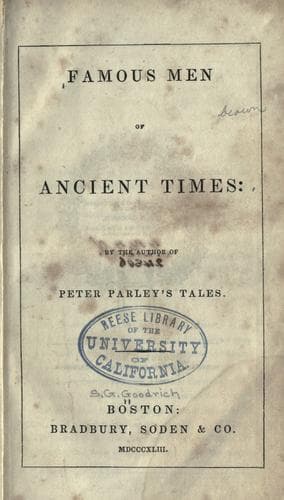
Famous Men of Ancient TimesGoodrich, Samuel G. (Samuel Griswold)
History
Famous Men of Ancient Times
Goodrich, Samuel G. (Samuel Griswold)
Biography -- Juvenile literature; Men -- Biography -- Juvenile literature
Although the Greeks at this time were zealously devoted to their
heathen mythology, Socrates was a sincere worshipper of the Supreme
Being; yet, from his care not to offend his weaker brethren, he
observed, with punctilious exactness, the religious uses which
antiquity and custom had consecrated. He was constantly attended by a
circle of disciples, who caught from him the spirit of free inquiry,
and were inspired with his zeal for the highest good, for religion,
truth and virtue. The succeeding schools of philosophy in Greece
are therefore justly traced back to him; and he is to be regarded
as the master who gave philosophical investigation among the Greeks
its highest direction. Among his most distinguished disciples were
Alcibiades, Crito, Xenophon, Antisthenes, Aristippus, Phædon, Æschines,
Cebes, Euclid, and Plato. From the detached accounts given us by
Xenophon and Plato, it appears that he instructed them in politics,
rhetoric, logic, ethics, arithmetic, and geometry, though not in a
systematic manner. He read with them the principal poets, and pointed
out their beauties; he labored to enlighten and correct their opinions
on all practical subjects, and to excite them to the study of whatever
is most important to men.
To make his instructions attractive, they were delivered, not in long
lectures, but in free conversations, rendered interesting by question
and answer. He did not reason _before_, but _with_ his disciples, and
thus exercised an irresistible power over their minds. He obliged
them to think for themselves, and if there was any capacity in a man,
it could not fail to be excited by his conversation. This method of
question and answer is called the _Socratic method_. The fragments of
his conversations, preserved by Xenophon, often leave us unsatisfied;
Plato alone has transmitted to us the genuine spirit of this method;
and he was therefore viewed by the ancients as the only fountain of the
Socratic philosophy,—a fact which has been too much disregarded by
modern writers.
Socrates fell a victim to the spirit of bigotry, which has sacrificed
so many persons, who were in advance of the age. The document
containing the accusation against him was lodged in the Temple of
Cybele, as late as the second century of the Christian era. The
following is a translation:—“Melitus, son of Melitus, accuses
Socrates, son of Sophroniscus, of being guilty of denying the existence
of the gods of the republic, making innovations in the religion of the
Greeks, and of corrupting the Athenian youth. Penalty,—death.”
Public-domain text, read in full here on John Shaqi.
Reviews
Reviews
No reviews yet
Be the first to share your thoughts on this work.
Elsewhere in the archive
Join the Discussion
Join the discussion
Sign in to leave a comment or review.
Sign InorCreate an account