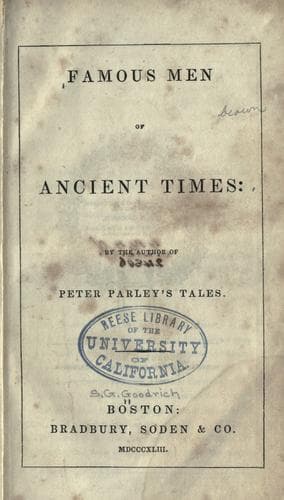
Famous Men of Ancient TimesGoodrich, Samuel G. (Samuel Griswold)
History
Famous Men of Ancient Times
Goodrich, Samuel G. (Samuel Griswold)
Biography -- Juvenile literature; Men -- Biography -- Juvenile literature
When Socrates formed the resolution of devoting himself to the pursuit
of divine and human knowledge, the sophists, a set of arrogant
philosophers, were perverting the heads and corrupting the hearts of
the Grecian youth. He therefore put himself in opposition to these
false guides, and went about endeavoring to instruct everybody in a
wiser and better philosophy than that which prevailed. He was, in fact,
an instructor of the people; and, believing himself an ambassador of
God, he was occupied from the dawn of day in seeking persons whom he
might teach either what is important to mankind in general, or the
private circumstances of individuals. He went to the public assemblies
and the most crowded streets, or entered the workshops of mechanics
and artists, and conversed with the people on religious duties, on
their social and political relations; on all subjects, indeed, relating
to morals, and even on agriculture, war, and the arts. He endeavored
to remove prevailing prejudices and errors, and to substitute right
principles; to awaken their better genius in the minds of his hearers;
to encourage and console them; to enlighten and improve mankind, and
make them really happy.
It is manifest that such a course must have been attended with great
difficulties. But the serenity of Socrates was undisturbed; he was
always perfectly cheerful in appearance and conversation. In the
market-place and at home, among people and in the society of those
whom love of truth and virtue connected more closely with him, he
was always the same. It cannot be doubted that a happy physical and
mental temperament contributed to produce this equanimity. But it was,
likewise, a fruit of self-discipline and the philosophy he taught. He
treated his body as a servant, and inured it to every privation, so
that moderation was to him an easy virtue; and he retained in old age
his youthful vigor, physical and mental. He was kind as a husband and
a father. Though his wife, Xantippe, was a noted shrew, he viewed her
as an excellent instrument of discipline, and treated her with patience
and forbearance.
Public-domain text, read in full here on John Shaqi.
Reviews
Reviews
No reviews yet
Be the first to share your thoughts on this work.
Elsewhere in the archive
Join the Discussion
Join the discussion
Sign in to leave a comment or review.
Sign InorCreate an account