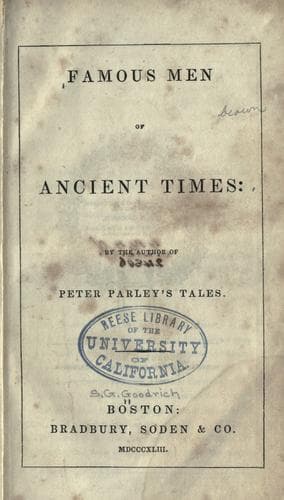
Famous Men of Ancient TimesGoodrich, Samuel G. (Samuel Griswold)
History
Famous Men of Ancient Times
Goodrich, Samuel G. (Samuel Griswold)
Biography -- Juvenile literature; Men -- Biography -- Juvenile literature
The other class was composed of the superstitious and bigoted,—of
the vicious and imbecile,—who were daily exposed to the censures
and sarcasms of the philosopher; in fine, of that set of narrow,
jealous-minded men, who looked upon the welfare and fame of their
neighbors with envy and with malice. The race that had exiled
Aristides, because he was great, was ready to condemn Socrates, because
he was wise. The friends and disciples of the great philosopher saw
the danger that menaced him, and with anxiety and fear they crowded
around their master, supplicating him to fly, or to adopt some means of
defence; but he would do neither. Lysias, one of the most celebrated
orators of the day, composed a pathetic oration, which he wished his
friend to pronounce, as his defence, in the presence of his judges.
Socrates read it, praised its animated and eloquent style, but rejected
it, as being neither manly nor expressive of fortitude. The anxiety
and trouble of avoiding condemnation appeared to him of little moment,
when compared to the performance of his duty in upholding to the last
moment, the truth of his principles and the dignity of his character.
Socrates, though both eloquent and persuasive in conversation, was not
capable of addressing a large assembly; therefore, on the day of his
trial, he asked permission of his judges to use the means of defence to
which he had been accustomed; namely, to speak familiarly with, and ask
questions of, his adversaries.
“Athenians,” he said, in commencing, “I hope I shall succeed in my
defence, if, by succeeding, good may result from it; but I look upon my
success as very doubtful, and, therefore, do not deceive myself in that
respect. But let the will of the gods be obeyed.”
The two chief accusations against Socrates, were firstly, that he
did not believe in the religion of the state; secondly, that he was
guilty of corrupting the minds of young men, and of disseminating the
disbelief of the established religion.
Public-domain text, read in full here on John Shaqi.
Reviews
Reviews
No reviews yet
Be the first to share your thoughts on this work.
Elsewhere in the archive
Join the Discussion
Join the discussion
Sign in to leave a comment or review.
Sign InorCreate an account