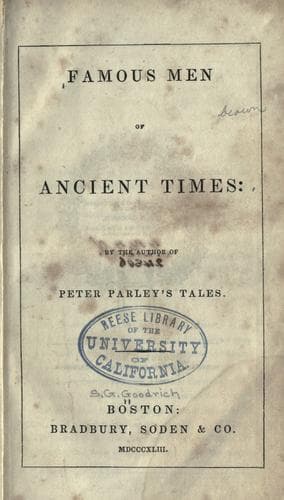
Famous Men of Ancient TimesGoodrich, Samuel G. (Samuel Griswold)
History
Famous Men of Ancient Times
Goodrich, Samuel G. (Samuel Griswold)
Biography -- Juvenile literature; Men -- Biography -- Juvenile literature
Socrates did not reply, in a direct manner, to either of these charges.
Instead of declaring that he believed in the religion of his country,
he proved that he was not an atheist; instead of refuting the charge of
instructing youth to doubt the sacred tenets of the law, he declared
and demonstrated that it was morality which he taught; and instead of
appealing to the compassion of his judges, he did not disguise the
contempt in which he held the means practised by parties accused, who,
in order to excite sympathy and compassion, brought their children and
relations to supplicate, with tears in their eyes, the mercy of the
judges. “I, also, have friends and relations!” he said, “and, as to
children, I have three,—one a stripling, the other two in childhood;
yet I will not allow them to come here to excite your sympathy.
Why will I not do so? It is not caused by stubbornness, nor by any
disdain I have for you. For my honor, for your honor, for that of the
republic, it is not meet that, with the reputation, whether true or
false that I have acquired, I should make use of such means to procure
your acquittal. Indeed, I should be ashamed if those that distinguish
themselves for wisdom, courage, or any other virtue, should, like many
people that I have seen, although they have passed for great men,
commit actions the most grovelling—as if death were the greatest
misfortune that could befall them, and that,—if their lives were
spared,—they would become immortal!”
When Socrates had ceased speaking, the judges of the Areopagus found
him guilty, by a majority of three. On being demanded, according to
the spirit of the Athenian laws, to pass sentence on himself, and
to mention the death he preferred, Socrates, conscious of his own
innocence, replied,—“Far from deeming myself guilty, I believe that
I have rendered my country important services, and, therefore, think
that I ought to be maintained in the Prytaneum at the public expense,
during the remainder of my life,—an honor, O Athenians, that I merit
more than the victors of the Olympic games. They make you happy in
appearance; I have made you so in reality.”
This reply in the highest degree exasperated his judges, who condemned
him to die by poison. When the sentence was passed, Socrates remained,
for a few minutes, calm and undisturbed, and then asked permission to
speak a few words.
Public-domain text, read in full here on John Shaqi.
Reviews
Reviews
No reviews yet
Be the first to share your thoughts on this work.
Elsewhere in the archive
Join the Discussion
Join the discussion
Sign in to leave a comment or review.
Sign InorCreate an account