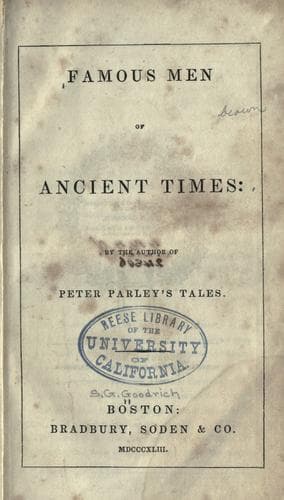
Famous Men of Ancient TimesGoodrich, Samuel G. (Samuel Griswold)
History
Famous Men of Ancient Times
Goodrich, Samuel G. (Samuel Griswold)
Biography -- Juvenile literature; Men -- Biography -- Juvenile literature
“Athenians,” he said, “your want of patience will be used as a pretext
by those who desire to defame the republic. They will tell you that
you have put to death the wise Socrates; yes, they will call me wise,
to add, to your shame—though I am not so. If you had but waited a
short time, death would have come of itself, and thus saved you from
disgracing yourselves. You see I am already advanced in years and must
shortly die. All know that in times of war, nothing is more easy than
saving our lives by throwing down our weapons, and demanding quarter of
the enemy. It is the same in all dangers; a thousand pretexts can be
found by those who are not scrupulous about what they say and do. It is
difficult, O Athenians, to avoid death; but it is much more so to avoid
crime, which is swifter than death. It is for this reason that, old and
feeble as I am, I await the latter, whilst my accusers, who are more
vigorous and volatile, embrace the former. I am now about to suffer the
punishment to which you have sentenced me; my accusers, the odium and
infamy to which virtue condemns them.”
“What is going to happen to me,” he added, “will be rather an advantage
than an evil; for it is apparent, that to die at present, and to be
delivered of the cares of this life, is what will best suit me. I have
no resentment towards my accusers, neither have I any ill-will against
those who condemn me, although their intention was to injure me, to do
all in their power to do me harm. I will make but one request; when
my children are grown up, if they are seen to covet riches, or prefer
wealth to virtue, punish and torment them as I have tormented you; and
if they look upon themselves as beings of importance, make them blush
for their presumption. This is what I have done to you. If you do that,
you will secure the gratitude of a father, and my children will ever
praise you. But it is time that we should separate; I go to die, and
you to live. Which of us has the best portion? No one knows except God.”
When he had finished, he was taken to prison and loaded with chains.
His execution was to have taken place in twenty-four hours, but it
was postponed for thirty days, on account of the celebration of the
Delian festivals. Socrates, with his usual cheerfulness and serenity,
passed this time in conversing with his friends upon some of the most
important subjects that could engage the mind of man. Plato relates,
in the dialogue entitled The Phedon, the conversation which took place
on the day preceding his death. That dialogue, without exception, is
the most beautiful that the Greeks have left us. We can give only those
passages which are more immediately connected with his death.
Public-domain text, read in full here on John Shaqi.
Reviews
Reviews
No reviews yet
Be the first to share your thoughts on this work.
Elsewhere in the archive
Join the Discussion
Join the discussion
Sign in to leave a comment or review.
Sign InorCreate an account