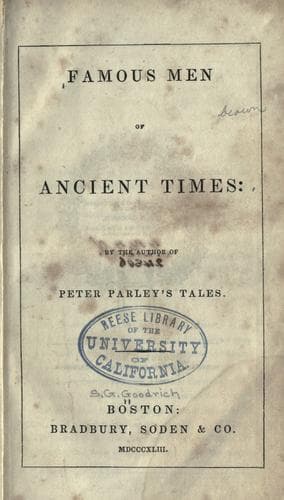
Famous Men of Ancient TimesGoodrich, Samuel G. (Samuel Griswold)
History
Famous Men of Ancient Times
Goodrich, Samuel G. (Samuel Griswold)
Biography -- Juvenile literature; Men -- Biography -- Juvenile literature
“I will follow your counsel,” said Socrates. Then turning to his
disciples, he continued, “Observe the honesty of that poor man.
During my imprisonment, he has visited me daily, and now, see with
what sincerity he weeps for me!” When the slave brought the poison to
Socrates, the latter looked at him, and said, “Very well, my friend,
what must I do? for you know best, and it is your business to direct
me.”
“Nothing else but drink the poison; then walk, and when you find
your limbs grow stiff, lie down upon your bed.” At the same time, he
handed the cup to Socrates, who took it without emotion or change of
countenance; then looking at the man with a steady eye, he said,—“Tell
me, is it allowable to make a drink-offering of this mixture?”
“Socrates,” the man replied, “we never prepare more than what is
sufficient for one dose.”
“I understand you,” said Socrates; “but nevertheless, it is lawful for
me to pray to God that he may bless my voyage, and render it a happy
one.” Having said so, he raised the cup to his lips, and drank the
poison with astonishing tranquillity and meekness. When Socrates looked
around and saw his friends vainly endeavoring to stifle their tears,
he said, “What are you doing, my companions? Was it not to avoid this,
that I sent away the women? and you have fallen into their weakness. Be
quiet, I pray you, and show more fortitude.”
In the mean time, he continued to walk, and when he felt his legs grow
stiff, he lay down upon his back, as had been recommended. The person
who gave Socrates the poison, then came forward, and, after examining
his legs and feet, he bound them, and asked if he felt the cord. The
dying philosopher answered, “No;” and feeling himself with his hand,
he told his disciples, that “when the cold reached his heart, he should
leave them.”
A few minutes afterwards, he exclaimed, “Crito, we owe a cock to
Esculapius; do not forget to pay the debt.” These were the last words
of Socrates. Such was the end of the great philosopher; and it may be
truly said that he was one of the wisest, best, and most upright of all
the Athenians.
In personal appearance Socrates was disagreeable: he had a sunken
nose, and his eyes protruded so as to give him a strange appearance.
It is supposed that he knew the shrewish temper of Xantippe, before he
married her, and sought the alliance that she might give exercise to
his patience. She tried every means to irritate him, and finding it
impossible to rouse his anger, she poured some dirty water upon him
from a window. “After thunder, we generally have rain,” was the only
remark the philosopher deigned to make. Many other anecdotes are handed
down, which show the wonderful command Socrates had acquired over
himself.
[Illustration]
[Illustration]
ALCIBIADES.
Public-domain text, read in full here on John Shaqi.
Reviews
Reviews
No reviews yet
Be the first to share your thoughts on this work.
Elsewhere in the archive
Join the Discussion
Join the discussion
Sign in to leave a comment or review.
Sign InorCreate an account