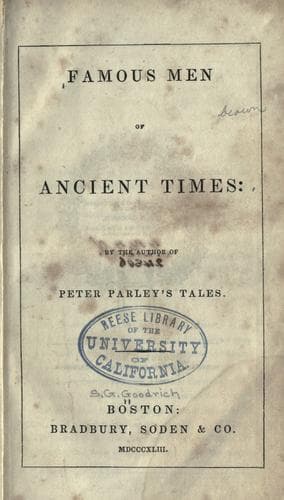
Famous Men of Ancient TimesGoodrich, Samuel G. (Samuel Griswold)
History
Famous Men of Ancient Times
Goodrich, Samuel G. (Samuel Griswold)
Biography -- Juvenile literature; Men -- Biography -- Juvenile literature
This eminent Athenian general and statesman, was born about 450 B.
C. Descended on both sides from the most illustrious families of his
country,—born to the inheritance of great wealth,—endued with great
personal beauty and the most brilliant mental qualities,—it seemed
evident, from his early youth, that he would exert no slight influence
over the counsels and fortunes of Athens. His father, Cleinias, was
killed at the battle of Cheronæa, and being thus an orphan, he was
placed under the wardship of his uncle, Pericles. The latter was too
much engaged in affairs of state to bestow that care upon Alcibiades,
which the impetuosity of his disposition required. In his childhood
he showed the germ of his future character. One day, when he was
playing at dice with some companions in the street, a wagon came up;
he requested the driver to stop, and, the latter refusing, Alcibiades
threw himself before the wheel, exclaiming, “Drive on, if thou darest!”
He excelled alike in mental and bodily exercises. His beauty and birth,
and the high station of Pericles, procured him a multitude of friends
and admirers, and his reputation was soon injured by the dissipation in
which he became involved. He was fortunate in acquiring the friendship
of Socrates, who endeavored to lead him to virtue, and undoubtedly
obtained a great ascendency over him, so that Alcibiades often quitted
his gay associates for the company of the philosopher.
He bore arms, for the first time, in the expedition against Potidæa and
was wounded. Socrates, who fought at his side, defended him, and led
him out of danger. In the battle of Delium, he was among the cavalry
who were victorious, but, the infantry being beaten, he was obliged to
flee, as well as the rest. He overtook Socrates, who was retreating on
foot. Alcibiades accompanied him, and protected him.
[Illustration: _Socrates saving Alcibiades._]
For a considerable time he took no part in public affairs, but on the
death of Cleon, 422 B. C., Nicias succeeded in making a peace for fifty
years, between the Athenians and Lacedæmonians. Alcibiades, jealous of
the influence of Nicias, and offended because the Lacedæmonians, with
whom he was connected by the ties of hospitality, had not applied to
him, sought to bring about some disagreement between the two nations.
The Lacedæmonians sent ambassadors to Athens. Alcibiades received them
with apparent good-will, and advised them to conceal their credentials,
lest the Athenians should prescribe conditions to them. They suffered
themselves to be duped, and, when called into the assembly, declared
that they were without credentials. Alcibiades rose immediately, stated
that they had credentials, accused them of ill-faith, and induced the
Athenians to form an alliance with the Argives. A breach with the
Lacedæmonians was the immediate consequence. Alcibiades commanded
the Athenian fleet several times during the war, and devastated the
Peloponnesus.
Public-domain text, read in full here on John Shaqi.
Reviews
Reviews
No reviews yet
Be the first to share your thoughts on this work.
Elsewhere in the archive
Join the Discussion
Join the discussion
Sign in to leave a comment or review.
Sign InorCreate an account