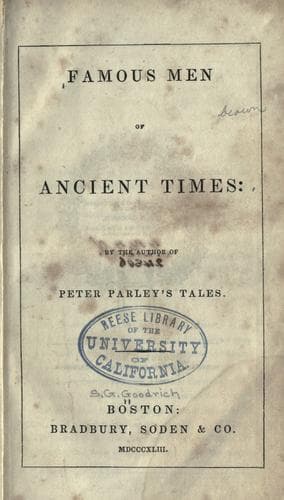
Famous Men of Ancient TimesGoodrich, Samuel G. (Samuel Griswold)
History
Famous Men of Ancient Times
Goodrich, Samuel G. (Samuel Griswold)
Biography -- Juvenile literature; Men -- Biography -- Juvenile literature
He did not, however, refrain from luxury and dissipation, to which he
abandoned himself after his return from the wars. On one occasion,
after having a nocturnal revel, in the company of some friends, he laid
a wager that he would give Hipponicus a box on the ear; which he did.
This act made a great noise in the city, but Alcibiades went to the
injured party, threw off his garments, and called upon him to revenge
himself by whipping him with rods. This open repentance reconciled
Hipponicus, who not only pardoned him, but gave him afterwards his
daughter, Hipparete, in marriage, with a portion of ten talents—about
ten thousand dollars. Alcibiades, however, still continued his levity
and prodigality. His extravagance was conspicuous at the Olympic
games, where he entered the stadium, not like other rich men, with one
chariot, but with seven at a time—and gained the three first prizes.
He seems also to have been victor in the Pythian and Nemæan games. By
these courses he drew upon himself the hatred of his fellow citizens,
and he would have fallen a sacrifice to the ostracism, if he had
not, in connection with Nicias and Phæax, who feared a similar fate,
artfully contrived to procure the banishment of his most formidable
enemy.
Soon afterwards, the Athenians, at the instance of Alcibiades, resolved
on an expedition against Sicily, and elected him commander-in-chief,
together with Nicias and Lamachus. But, during the preparations, it
happened one night that all the statues of Mercury were broken. The
enemies of Alcibiades charged him with the act, but postponed a public
accusation till he had set sail, when they stirred up the people
against him to such a degree, that he was recalled in order to be
tried. Alcibiades had been very successful in Sicily, when he received
the order to return. He prepared to obey, and embarked, but on reaching
Thurium, he landed, and, instead of proceeding to Athens, concealed
himself. Some one asking him, “How is this, Alcibiades? Have you no
confidence in your country?”—he replied, “I would not trust my mother
when my life is concerned, for she might, by mistake, take a black
stone instead of a white one.” He was condemned to death in Athens.
When the news reached him, he remarked—“I shall show the Athenians
that I am yet alive.”
Public-domain text, read in full here on John Shaqi.
Reviews
Reviews
No reviews yet
Be the first to share your thoughts on this work.
Elsewhere in the archive
Join the Discussion
Join the discussion
Sign in to leave a comment or review.
Sign InorCreate an account