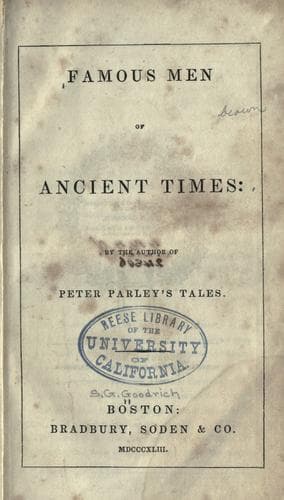
Famous Men of Ancient TimesGoodrich, Samuel G. (Samuel Griswold)
History
Famous Men of Ancient Times
Goodrich, Samuel G. (Samuel Griswold)
Biography -- Juvenile literature; Men -- Biography -- Juvenile literature
Democritus, one of the most remarkable of the philosophers of
antiquity, was born at Abdera, a maritime city of Thrace, 460 B. C. He
travelled over the greatest part of Europe, Asia and Africa, in quest
of knowledge. Though his father was so rich as to entertain Xerxes
and his whole army, while marching against Greece, and left his son a
large fortune, yet the latter returned from his travels in a state of
poverty. It was a law of the country, that a man should be deprived
of the honor of a funeral, who had reduced himself to indigence.
Democritus was of course exposed to this ignominy; but having read
before his countrymen his chief work, it was received with the greatest
applause, and he was presented with five hundred talents,—a sum nearly
equal to half a million of dollars. Statues were also erected to his
honor; and a decree was passed that the expenses of his funeral should
be paid from the public treasury.
These circumstances display alike the great eminence of the
philosopher, and an appreciation of genius and learning on the part
of the people, beyond what could now be found in the most civilized
communities of the world. Where is the popular assembly of the present
day, that would bestow such a reward, on such an occasion?
After his return from his travels, Democritus retired to a garden
near the city, where he dedicated his time to study and solitude;
and, according to some authors, put out his eyes, to apply himself
more closely to philosophical inquiries. This, however, is unworthy
of credit. He was accused of insanity, and Hippocrates, a celebrated
physician, was ordered to inquire into the nature of his disorder.
After a conference with the philosopher, he declared that not the
latter, but his enemies were insane. Democritus was so accustomed to
laugh at the follies and vanities of mankind, who distract themselves
with care, and are at once the prey to hope and anxiety, that he
acquired the title of the “laughing philosopher,” in contrast to
Heraclitus,[12] who has been called the “weeping philosopher.” He told
Darius, the king, who was inconsolable for the loss of his wife, that
he would raise her from the dead if he could find three persons who had
gone through life without adversity, and whose names he might engrave
on the queen’s monument. The king’s inquiries after such, proved
unavailing, and the philosopher discovered the means of soothing the
sorrows of the sovereign.
He was a disbeliever in the existence of ghosts; and some youths, to
try his fortitude, dressed themselves in hideous and deformed habits,
and approached his cave in the dead of night, expecting to excite his
terror and astonishment. The philosopher received them unmoved, and,
without hardly deigning to bestow upon them a look, desired them to
cease making themselves such objects of ridicule and folly. He died in
the one hundred and fourth year of his age, B. C. 357.
Public-domain text, read in full here on John Shaqi.
Reviews
Reviews
No reviews yet
Be the first to share your thoughts on this work.
Elsewhere in the archive
Join the Discussion
Join the discussion
Sign in to leave a comment or review.
Sign InorCreate an account