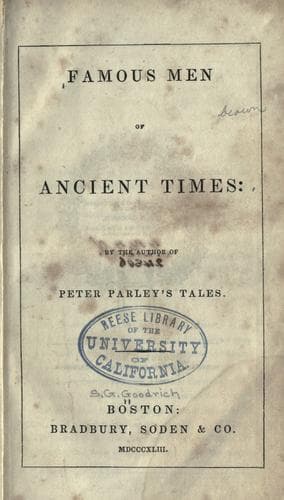
Famous Men of Ancient TimesGoodrich, Samuel G. (Samuel Griswold)
History
Famous Men of Ancient Times
Goodrich, Samuel G. (Samuel Griswold)
Biography -- Juvenile literature; Men -- Biography -- Juvenile literature
All the works of Democritus, which were numerous, are lost. He was
the first to teach that the milky way was occasioned by a confused
light from a multitude of stars. He may be considered as the parent of
experimental philosophy; in the prosecution of which he was so ardent,
that he declared he would prefer the discovery of one of the causes of
the works of nature, to the diadem of Persia. He is said to have made
artificial emeralds by chemical means, and to have tinged them with
various colors; he likewise found the art of dissolving stones and
softening ivory.
He was the author of the atomic theory; he viewed all matter, in which
he included mind, as reducible to atoms; he considered the universe to
consist only of matter and empty space. The mind he regarded as round
atoms of fire. He argued that nothing could arise out of nothing; and
also that nothing could utterly perish and become nothing. Hence he
inferred the eternity of the universe, and dispensed with the existence
of a Creator.
He explained the difference in substances by a difference in their
component atoms; and all material phenomena, by different motions,
backward or forward, taking place of necessity. He did not seem to
perceive that under this word, _necessity_, he concealed a deity. He
explained sensation by supposing sensible images to issue from bodies.
In moral philosophy, he only taught that a cheerful state of mind was
the greatest attainable good.
The theories of Democritus appear absurd enough in our time; but
philosophy was then in its infancy. His struggles after light and truth
display the darkness of the age, and the ingenuity of the philosopher.
They may also teach us by what a process of mental toil, for centuries
piled upon centuries, the knowledge we possess has been attained. The
school he established, was supplanted, about a century after, by that
of Epicurus.
[Illustration]
[Footnote 12: Heraclitus flourished about 500 years B. C. He was a
native of Ephesus; and being of a melancholy disposition, he spent
his time in mourning and weeping over the frailties of human nature,
and the miseries of human life. He employed himself for a time, in
writing different treatises, in which he maintained that all things
are governed by a fatal necessity. His opinions, in some things, were
adopted by the Stoics. He became at last a man-hater, and retired to
the mountains, so as to be entirely separated from his fellow-men. Here
he fed on grass, which brought on a dropsical complaint: to get cured
of this, he returned to the town. He established his residence on a
dunghill, hoping that the warmth might dissipate his disease; but this
proved ineffectual, and he died in his sixtieth year.]
[Illustration]
PERICLES.
Public-domain text, read in full here on John Shaqi.
Reviews
Reviews
No reviews yet
Be the first to share your thoughts on this work.
Elsewhere in the archive
Join the Discussion
Join the discussion
Sign in to leave a comment or review.
Sign InorCreate an account