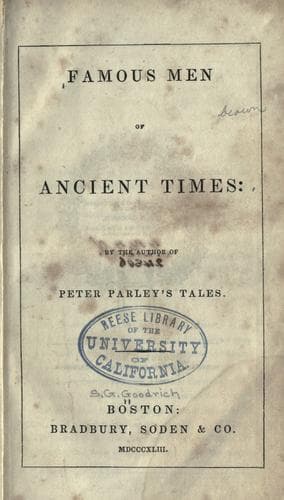
Famous Men of Ancient TimesGoodrich, Samuel G. (Samuel Griswold)
History
Famous Men of Ancient Times
Goodrich, Samuel G. (Samuel Griswold)
Biography -- Juvenile literature; Men -- Biography -- Juvenile literature
The value of fables, as instruments of instruction, is attested by
Addison, in the following words. “They were,” says he, “the first
pieces of wit that made their appearance in the world; and have been
still highly valued, not only in times of the greatest simplicity, but
among the most polite ages of mankind. Jotham’s fable of the Trees is
the oldest that is extant, and as beautiful as any which have been
made since that time. Nathan’s fable of the Poor Man and his Lamb is
likewise more ancient than any that is extant, excepting the above
mentioned, and had so good an effect as to convey instruction to the
ear of a king, without offending it, and to bring the ‘man after God’s
own heart’ to a right sense of his guilt and his duty. We find Æsop
in the most distant ages of Greece. And, if we look into the very
beginning of the commonwealth of Rome, we see a mutiny among the common
people appeased by the fable of the Belly and the Members; which was
indeed very proper to gain the attention of an incensed rabble, at
a time when perhaps they would have torn to pieces any man who had
preached the same doctrine to them in an open and direct manner. As
fables took their birth in the very infancy of learning, they never
flourished more than when learning was at its greatest height. To
justify this assertion, I shall put my reader in mind of Horace, the
greatest wit and critic in the Augustan age; and of Boileau, the most
correct poet among the moderns; not to mention La Fontaine, who, by
this way of writing, is come more into vogue than any other author of
our times.”
“Reading is to the mind,” continues the writer, “what exercise is
to the body: as, by the one, health is preserved, strengthened, and
invigorated, by the other, virtue, (which is the health of the mind,)
is kept alive, cherished and confirmed. But, as exercise becomes
tedious and painful when we make use of it only as the means of health,
so reading is too apt to grow uneasy and burdensome, when we apply
ourselves to it only for our improvement in virtue. For this reason,
the virtue which we gather from a fable or an allegory, is like the
health we get by hunting, as we are engaged in an agreeable pursuit
that draws us on with pleasure, and makes us insensible of the fatigues
that accompany it.”
Public-domain text, read in full here on John Shaqi.
Reviews
Reviews
No reviews yet
Be the first to share your thoughts on this work.
Elsewhere in the archive
Join the Discussion
Join the discussion
Sign in to leave a comment or review.
Sign InorCreate an account