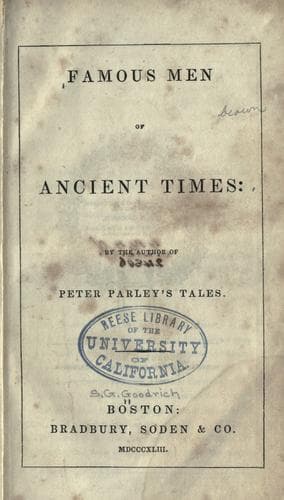
Famous Men of Ancient TimesGoodrich, Samuel G. (Samuel Griswold)
History
Famous Men of Ancient Times
Goodrich, Samuel G. (Samuel Griswold)
Biography -- Juvenile literature; Men -- Biography -- Juvenile literature
All now fixed their eyes upon him as a deliverer, and he was
unanimously elected archon. He might have become absolute, but he
refused the dangerous office of king of Athens, and, in the capacity
of lawgiver, he began to make a reform in every department of the
government. The complaints of the poorer citizens found redress; all
debts were remitted, and no one was permitted to seize the person of
his debtor, if he was unable to make payment. After he had established
the most salutary regulations in the state, and bound the Athenians
by a solemn oath that they would faithfully observe his laws for the
space of one hundred years, Solon resigned the office of legislator,
and removed himself from Athens. He visited Egypt, and the court of
Croesus,[14] king of Lydia—celebrated for his wealth, and the vanity
of desiring to be esteemed the happiest of mankind. He here declared
to the monarch that an Athenian, who had always seen his country
flourish—who had virtuous children, and who fell in defence of his
native land, had a happier career than the proudest emperor on the
globe.
After ten years’ absence, Solon returned to Athens; but he had the
mortification to find the greatest part of his regulations disregarded,
through the factious spirit of his countrymen and the usurpation of
Pisistratus. Not to be longer a spectator of the divisions that reigned
in his country, he retired to Cyprus, where he died at the court of
king Philocyprus, in the eightieth year of his age. The laws of Solon
became established in Athens, and their salutary consequences can be
discovered in the length of time they were in force in the republic.
For above four hundred years they flourished in full vigor, and Cicero,
who was himself a witness of their benign influence, passes the highest
encomiums upon the legislator, whose superior wisdom framed such a code
of regulations.
It was the intention of Solon to protect the poorer citizens; and by
dividing the whole body of the Athenians into four classes, three of
which were permitted to discharge the most important offices and
magistracies of the state, and the last to give their opinion in the
assemblies, but not have a share in the distinctions and honors of
their superiors; the legislator gave the populace a privilege, which,
though at first small and inconsiderable, soon rendered them masters
of the republic, and of all the affairs of government. He made a
reformation in the Areopagus, increased the authority of the members,
and permitted them yearly to inquire how every citizen maintained
himself, and to punish such as lived in idleness, and were not employed
in some honorable and lucrative profession. He also regulated the
Prytaneum, and fixed the number of its judges to four hundred.
Public-domain text, read in full here on John Shaqi.
Reviews
Reviews
No reviews yet
Be the first to share your thoughts on this work.
Elsewhere in the archive
Join the Discussion
Join the discussion
Sign in to leave a comment or review.
Sign InorCreate an account