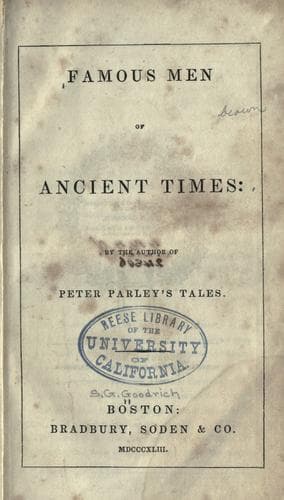
Famous Men of Ancient TimesGoodrich, Samuel G. (Samuel Griswold)
History
Famous Men of Ancient Times
Goodrich, Samuel G. (Samuel Griswold)
Biography -- Juvenile literature; Men -- Biography -- Juvenile literature
The sanguinary laws of Draco were all cancelled except that against
murder; and the punishment denounced against every offender was
proportioned to his crime; but Solon made no law against parricide
or sacrilege. The former of these crimes, he said, was too horrible
to human nature for a man to be guilty of it, and the latter could
never be committed, because the history of Athens had never furnished
a single instance. Such as had died in the service of their country,
were buried with great pomp, and their families were maintained at
the public expense; but such as had squandered away their estates,
such as refused to bear arms in defence of their country, or paid no
attention to the infirmity and distress of their parents, were branded
with infamy. The laws of marriage were newly regulated; it became an
union of affection and tenderness, and no longer a mercenary contract.
To speak with ill language against the dead, as well as against
the living, was made a crime; for the legislator wished that the
character of his fellow-citizens should be freed from the aspersions of
malevolence and envy. A person that had no children was permitted to
dispose of his estates as he pleased; females were not allowed to be
extravagant in their dress or expenses; licentiousness was punished;
and those accustomed to abandoned society, were deprived of the
privilege of addressing the public assemblies. These celebrated laws
were engraved on several tables; and that they might be better known
and more familiar to the Athenians, they were written in verse.
If we consider the time in which Solon lived, we shall see occasion to
regard him as a man of extraordinary wisdom and virtue. Nearly all the
systems of government around him were despotic. That government should
be instituted and conducted for the benefit of the governed; and that
the people are the proper depositories of power—principles recognised
in his institutions—were truths so deeply hidden from mankind, as to
demand an intellect of the highest order for their discovery.
Nor are his virtues and humanity less conspicuous than his sagacity.
While repealing the bloody code of Draco, he substituted mild and
equitable laws; he shunned the harsh and savage system of Lycurgus,
which sacrificed all the best feelings of the heart, and the most
refined pleasures of life, in order to sustain the martial character
of the state; and while he sought to soften the manners, he strove
to exalt the standard of public and private virtue, not only by his
laws, but by his conversation and example. He was thus, not only
the benefactor of Athens and of Greece, but—as one of the great
instruments of civilization throughout the world, and especially as
one of the leaders in the establishment of free government—mankind at
large owe him a lasting debt of gratitude.
[Illustration]
Public-domain text, read in full here on John Shaqi.
Reviews
Reviews
No reviews yet
Be the first to share your thoughts on this work.
Elsewhere in the archive
Join the Discussion
Join the discussion
Sign in to leave a comment or review.
Sign InorCreate an account