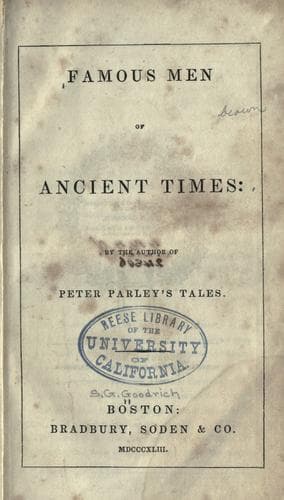
Famous Men of Ancient TimesGoodrich, Samuel G. (Samuel Griswold)
History
Famous Men of Ancient Times
Goodrich, Samuel G. (Samuel Griswold)
Biography -- Juvenile literature; Men -- Biography -- Juvenile literature
The vicissitudes to which Homer’s reputation and influence have been
subject, deserve notice. From the arrangement of the Iliad and Odyssey,
in the time of the Pisistratidæ, to the promulgation of Christianity,
the love and reverence with which the name of Homer was regarded, went
on constantly increasing, till at last public games were instituted in
his honor, statues dedicated, temples erected, and sacrifices offered
to him, as a divinity. There were such temples at Smyrna, Chios, and
Alexandria; and, according to Ælian, the Argives sacrificed to, and
invoked the names and presence of, Apollo and Homer together.
But about the beginning of the second century of the Christian era,
when the struggle between the old and the new religions was warm
and active, the tide turned. Heathenism, says Pope, was then to be
destroyed, and Homer appeared to be the father of those fictions which
were at once the belief of the Pagan religion, and the objections of
Christianity against it. He became, therefore, deeply involved in the
question, not with that honor which had hitherto attended him, but as
a criminal, who had drawn the world into folly. These times, however,
are past, and Homer stands on the summit of the ancient Parnassus, the
boast and glory of Greece, and the wonder and admiration of mankind.
The Iliad, with the exception of the Pentateuch and some others of the
books of the Old Testament, is the most ancient composition known. It
is interesting not only as a splendid poem, but also on account of the
light it throws upon the history and manners of the remote ages in
which it was written. We are struck with the similarity of the customs
of the Asiatic Greeks to those of the Hebrews, as set forth in the
Bible; and also with the fact that the Jupiter of Homer rises to that
unchecked omnipotence assigned to Jehovah.
The design of the Iliad seems to be to set forth the revenge which
Achilles took on Agamemnon, for depriving him of his mistress, Briseis,
while engaged in the siege of Troy—with the long train of evils which
followed. The admirers of Homer have pretended to discover in the work
the most profound art in the construction of the poem, and have hence
deduced rules for the formation of the epic poem; but nothing is more
clear than that, in the simple lines of Homer, the poet had no other
guide than a profound knowledge of human nature and human sympathies;
and that he only sought to operate on these by telling a plain story,
in the most simple, yet effective manner. The absence of all art is
one of the chief characteristics of the Iliad;—its naturalness is the
great secret of its power.
Public-domain text, read in full here on John Shaqi.
Reviews
Reviews
No reviews yet
Be the first to share your thoughts on this work.
Elsewhere in the archive
Join the Discussion
Join the discussion
Sign in to leave a comment or review.
Sign InorCreate an account