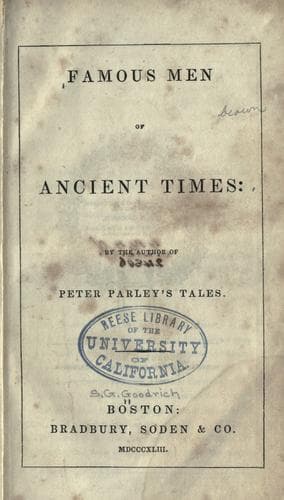
Famous Men of Ancient TimesGoodrich, Samuel G. (Samuel Griswold)
History
Famous Men of Ancient Times
Goodrich, Samuel G. (Samuel Griswold)
Biography -- Juvenile literature; Men -- Biography -- Juvenile literature
According to Herodotus, Homer died at Io, on his way to Athens, and
was buried near the sea-shore. Proclus says he died in consequence of
falling over a stone. Plutarch tells a different story. He preserves
two responses of an oracle to the poet, in both of which he was
cautioned to beware of the young men’s riddle; and relates that the
poet, being on a voyage to Thebes, to attend a musical or poetical
contest at the feast of Saturn, in that city, landed in the island
of Io, and, whilst sitting on a rock by the sea-shore, observed some
young fishermen in a boat. Homer asked them if they had anything, and
the young wags, who, having had no sport, had been diligently catching
and killing as many as they could, of certain personal companions of a
race not even yet extinct, answered,—“As many as we caught, we left;
as many as we could not catch, we carry with us.” The catastrophe of
this absurd story is, that Homer, being utterly unable to guess the
riddle, broke his heart, out of pure vexation; and the inhabitants of
the island buried him with great magnificence, and placed the following
inscription on his tomb:—
Here Homer, the divine in earthly bed,
Poet of Heroes, rests his sacred head.
The general theory in regard to the poems of Homer, is that they were
composed and recited by him, to the people living upon the islands and
the main land along the coasts of Asia Minor. At that time books were
unknown, and it is a question whether even the art of writing was then
practised. Homer, therefore, published his poems in the only way he
could do it—by oral delivery. Whether his verses were sung, or only
recited, we cannot determine; but there is no doubt that he obtained
both fame and maintenance by his performances.
So deep was the impression made by the poet, that his verses were
learned by heart, and preserved in the memories of succeeding
rhapsodists and minstrels. His reputation was diffused over all Greece;
and Lycurgus, who had heard of his compositions, is supposed to have
taken pains, during his travels, to have them written down, and to have
brought them in a collected form to Greece. They were, however, still
in fragments, and the task of arranging and uniting them was performed
by Pisistratus, with the help of the poets of his time. In this way,
they received nearly the form they now possess; the division of each of
the two epics into twenty-four books, corresponding with the letters
of the Greek alphabet, being the work of the Alexandrian critics,
some centuries after. It must be remembered, however, that although
the poems of Homer were thus committed to writing in the time of
Pisistratus, they continued to be recited by the rhapsodists, who were
much favored in Greece, and in this way alone, for several centuries,
were popularly known. It is probable that in these recitations, there
was a good deal of dramatic action, and that they possessed something
of the interest which belongs to theatrical representation.
Public-domain text, read in full here on John Shaqi.
Reviews
Reviews
No reviews yet
Be the first to share your thoughts on this work.
Elsewhere in the archive
Join the Discussion
Join the discussion
Sign in to leave a comment or review.
Sign InorCreate an account