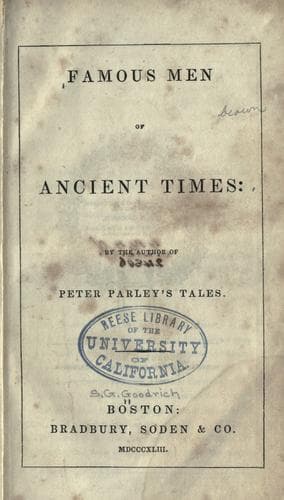
Famous Men of Ancient TimesGoodrich, Samuel G. (Samuel Griswold)
History
Famous Men of Ancient Times
Goodrich, Samuel G. (Samuel Griswold)
Biography -- Juvenile literature; Men -- Biography -- Juvenile literature
Beside the Iliad, another epic, divided into twenty-four books, and
entitled the Odyssey, with a number of smaller pieces, are attributed
to Homer, and doubtless upon good and substantial grounds. The Odyssey
is a tale of adventures, like Robinson Crusoe, and Sinbad the Sailor,
heightened by an object, and dignified by a moral far above these
works. It tells us what befel Ulysses, in returning from the siege of
Troy to his home in Greece; and is wrought up with wonderful powers
of invention and fancy. It is esteemed inferior, on the whole, to the
Iliad, and an eminent critic has said, that, in the former, Homer
appears like the rising, and in the latter, like the setting sun.
[Illustration]
[Footnote 15: These Marbles consist of a large collection of busts,
statues, altars, inscriptions, mutilated figures, &c., formed by Thomas
Howard, Earl of Arundel, in the early part of the seventeenth century,
and presented to the University of Oxford, by Henry Howard, the earl’s
grandson. They were obtained in various parts of Greece; many are of
great antiquity and of great value, as well for the light they shed
upon history as upon the arts, customs, and manners of past ages.]
[Illustration]
CONFUCIUS.
This greatest of Chinese philosophers was born in the petty kingdom
of Lú, now the province of Shántung, in the year 549 B. C.—the same
year that Cyrus became king of the Medes and Persians. The Chinese,
in their embellishments of his history, tell us that his birth was
attended with heavenly music, filling the air; that two dragons were
seen winding over the roof; that five old men appeared at the door,
and after consulting together, suddenly vanished; and that a unicorn
brought to his mother a tablet in his mouth. It is also related that
when he was born, five characters were seen on his breast, declaring
him to be “the maker of a rule for settling the world.” These and other
marvels are a part of the established biography of the philosopher, as
received by the Chinese.
The father of Confucius, who was a magistrate of the district where he
lived, died when the son was but three years old. The latter was poor
and unknown during his youth—though his gravity and attention to study
attracted the attention of his townsmen. When he approached manhood, he
was esteemed remarkable for his wisdom, and equal to the learned men of
the country in his knowledge of antiquity.
Public-domain text, read in full here on John Shaqi.
Reviews
Reviews
No reviews yet
Be the first to share your thoughts on this work.
Elsewhere in the archive
Join the Discussion
Join the discussion
Sign in to leave a comment or review.
Sign InorCreate an account