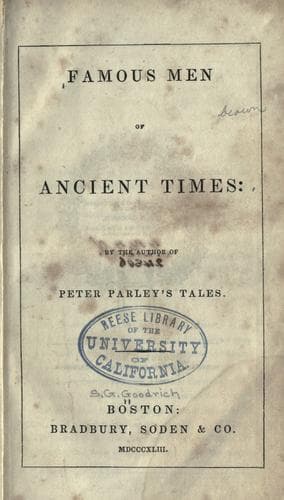
Famous Men of Ancient TimesGoodrich, Samuel G. (Samuel Griswold)
History
Famous Men of Ancient Times
Goodrich, Samuel G. (Samuel Griswold)
Biography -- Juvenile literature; Men -- Biography -- Juvenile literature
At the age of seventeen he received an appointment as clerk in the
grain department of the government; and so attentive was he in his
trust, as, two years after, to be advanced to the general supervision
of the fields and parks, and the breeding of cattle. About this time
he was married, and two years after, his only son was born. Upon this
occasion, Lord Cháu the governor of Lú, sent him two carp as a present,
and accordingly Confucius named his son Lí or Carp. His humor went even
farther, and he gave the boy the additional title of Piyü, or Uncle
Fish.
At the age of twenty-four, Confucius lost his mother, whom he buried in
the same grave with his father, who had been dead some time. He then
resigned his office, that he might mourn three years for his mother,
according to the ancient custom of the country. This practice had
fallen into neglect, and, consequently, the example of Confucius, in
following the holy custom of the fathers of the country, gained him
great renown for his piety. His reputation was thus extended, and his
example began to be followed.
The three years of his mourning were not lost—for he then devoted
himself to study. He diligently examined the books of the old authors,
seeking to discover the means by which the ancient kings and sages
sought to attain the perfection of morals. The result was, a conviction
that the social virtues were best cultivated by an observance of the
ancient usages of the country; and accordingly he resolved to devote
his life to them, and to their permanent establishment in China. This
great work he accomplished; and if we consider the effect he has
produced on the most populous nation of the globe, and during a space
of nearly two thousand years, we shall perceive the mighty consequence
of his labors. The actual amount of influence he has exercised, perhaps
exceeds that of any other human being, save Aristotle alone.
Appearing to have a clear view of his great work, Confucius entered
upon it with systematic diligence. He resolved to establish schools
where his philosophy should be taught to pupils who would go forth and
spread his doctrines through the empire. He also proposed to write a
series of books, setting forth his views. All these things he lived to
accomplish.
Public-domain text, read in full here on John Shaqi.
Reviews
Reviews
No reviews yet
Be the first to share your thoughts on this work.
Elsewhere in the archive
Join the Discussion
Join the discussion
Sign in to leave a comment or review.
Sign InorCreate an account