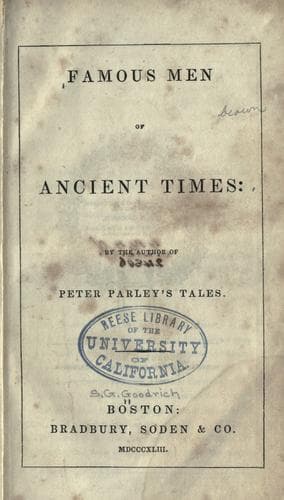
Famous Men of Ancient TimesGoodrich, Samuel G. (Samuel Griswold)
History
Famous Men of Ancient Times
Goodrich, Samuel G. (Samuel Griswold)
Biography -- Juvenile literature; Men -- Biography -- Juvenile literature
Confucius, thus disgraced in his own country, and now at the age of
fifty, left it, and retired to the kingdom of Wei, where he remained
more than ten years, without seeking to exercise any public office,
but principally occupied with completing his works, and instructing
his disciples in his doctrines. During his residence in Wei, he
frequently made excursions into other states, taking with him such of
his disciples as chose to accompany him. He was at times applauded
and esteemed, but quite as often was the object of persecution and
contempt. More than once his life was endangered. He compared himself
to a dog driven from his home: “I have the fidelity of that animal,
and I am treated like it. But what matters the ingratitude of men?
They cannot hinder me from doing all the good that is appointed me. If
my precepts are disregarded, I have the consolation in my own breast
of knowing that I have faithfully performed my duty.” He sometimes
spoke in a manner that showed his own impression to be that Heaven had
conferred on him a special commission to instruct the world. When an
attempt was made on his life, he said, “As Heaven has produced such a
degree of virtue in me, what can Hwántúi do to me?” On another occasion
of danger, he said, “If Heaven means not to obliterate this doctrine
from the earth, the men of Kwáng can do nothing to me.”
At the age of sixty-eight, after an absence of eighteen years,
Confucius returned to his native country, where he lived a life of
retirement, employed in putting the finishing hand to his works. In his
sixty-sixth year, his wife died, and his son, Piyü, mourned for her a
whole year; but one day overhearing his father say, “Ah! it is carried
too far;” he dried up his tears. Three years after this, this son also
died, leaving a son, Tsz’sz’, who afterwards emulated his grandfather’s
fame as a teacher, and became the author of the Chung Yung, or True
Medium. The next year, Yen Hwui, the favorite disciple of the sage,
died, whose loss he bitterly mourned, saying, “Heaven has destroyed me!
heaven has destroyed me!” He had great hopes of this pupil, and had
depended upon him to perpetuate his doctrines.
Public-domain text, read in full here on John Shaqi.
Reviews
Reviews
No reviews yet
Be the first to share your thoughts on this work.
Elsewhere in the archive
Join the Discussion
Join the discussion
Sign in to leave a comment or review.
Sign InorCreate an account