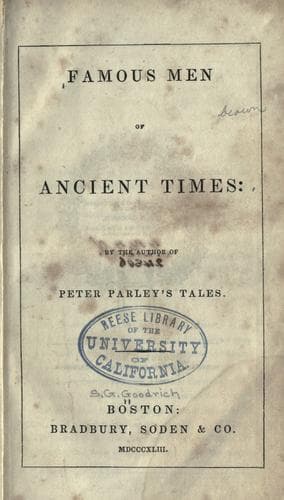
Famous Men of Ancient TimesGoodrich, Samuel G. (Samuel Griswold)
History
Famous Men of Ancient Times
Goodrich, Samuel G. (Samuel Griswold)
Biography -- Juvenile literature; Men -- Biography -- Juvenile literature
After several years of retirement, Confucius was called into public
life. The prince of Lú died, and his son, entertaining a great respect
for the philosopher, and esteem for his instructions, invited him to
court, in order to learn his doctrines more fully. After becoming well
acquainted with him, and reposing confidence in his integrity, the
young ruler committed the entire management of the state to him; and
the activity, courage, and disinterested conduct which he exhibited
in the exercise of his power, soon had the happiest effect upon the
country. By his wise rules and the authority of his example and his
maxims he soon reformed many vicious practices, and introduced
sobriety and order, in the place of waste and injustice. He occupied
himself with agriculture, and regulated the revenue and the manner of
receiving it; so that, in consequence of his measures, the productions
of the state were increased, the happiness of the people was extended,
and the revenue considerably augmented.
He carried his reforms into every department of justice, in which, soon
after he entered upon his duties as minister, he had an opportunity of
exhibiting his inflexibility. One of the most powerful nobles of the
state had screened himself from the just punishment due to his many
crimes, under the dread of his power and riches, and the number of his
retainers. Confucius caused him to be arrested, and gave order for his
trial; and when the overwhelming proofs brought forward had convinced
all of his guilt, he condemned him to lose his head, and presided
himself at the execution. This wholesome severity struck a dread into
other men of rank, and likewise obtained the plaudits of all men of
sense, as well as of the people, who saw in the minister a courageous
protector, ready to defend them against the tyranny of men in power.
These salutary reforms had not been long in operation, before the
neighboring states took alarm at the rising prosperity of Lú; and the
prince of Tsí, who had recently usurped the throne by assassinating
its occupant, resolved to ruin the plans of Confucius. To this end he
appointed an envoy to the young prince, with whose character he was
well acquainted, desiring to renew the ancient league of friendship
between the two countries. This envoy was charged with thirty-five
horses, beautifully caparisoned, a large number of curious rarities,
and twenty-four of the most accomplished courtesans he could procure in
his dominions. The scheme succeeded; before these seductive damsels,
the austere etiquette of the court of Lú soon gave way, and fetes,
comedies, dances, and concerts, took the place of propriety and
decorum. The presence of the sage soon became irksome to his master,
and he at last forbid him to come into his sight, having become quite
charmed with the fair enchantresses, and no longer able to endure the
remonstrances of his minister.
Public-domain text, read in full here on John Shaqi.
Reviews
Reviews
No reviews yet
Be the first to share your thoughts on this work.
Elsewhere in the archive
Join the Discussion
Join the discussion
Sign in to leave a comment or review.
Sign InorCreate an account