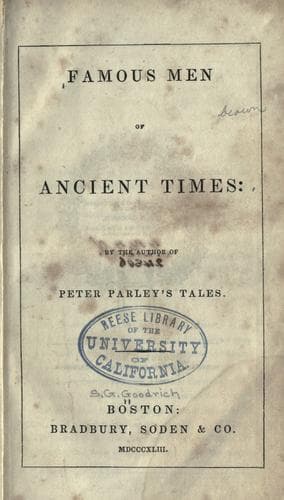
Famous Men of Ancient TimesGoodrich, Samuel G. (Samuel Griswold)
History
Famous Men of Ancient Times
Goodrich, Samuel G. (Samuel Griswold)
Biography -- Juvenile literature; Men -- Biography -- Juvenile literature
Towards the end of his days, when he had completed his revision of the
Five Classes, he, with great solemnity, dedicated them to Heaven. He
assembled all his disciples and led them out of the town to one of the
hills where sacrifices had been usually offered for many years. He here
erected a table, or altar, upon which he placed the books; and then,
turning his face to the north, adored Heaven, and returned thanks upon
his knees, in a humble manner, for having had life and strength granted
him to enable him to accomplish this laborious undertaking; he implored
heaven to grant that the benefit to his countrymen from so arduous a
labor might not be small. He had prepared himself for this ceremony by
privacy, fasting and prayer. Chinese pictures of this scene represent
the sage in the attitude of supplication, and a pencil of light, or
a rainbow, descending from the sky upon the books, while his scholars
stand around in admiring wonder.
In his seventy-third year, a few days before his death, leaning upon
his staff, Confucius tottered about the house, singing out,—
“The great mountain is broken!
The strong beam is thrown down!
The wise man is decayed!”
He then related a dream he had had the night before, to his pupil,
Tsz’kung, which he regarded as a presage of his own death; and, after
keeping his bed seven days, he died on the 18th day of the second
month, and was buried in the same grave with his wife. Tsz’kung mourned
for him six years in a shed erected by the side of his grave, and then
returned home. His death occurred 479 B. C., the year of the battle of
Platæa, in Greece, and about seven years before the birth of Socrates.
Many events of great importance happened during his life, in western
countries, of which the return of the Jews, and building of the second
temple, Xerxes’ invasion of Greece, the expulsion of the kings from
Rome, the conquest of Egypt, and establishment of the Persian monarchy
in its fullest extent, were the most important.
Public-domain text, read in full here on John Shaqi.
Reviews
Reviews
No reviews yet
Be the first to share your thoughts on this work.
Elsewhere in the archive
Join the Discussion
Join the discussion
Sign in to leave a comment or review.
Sign InorCreate an account