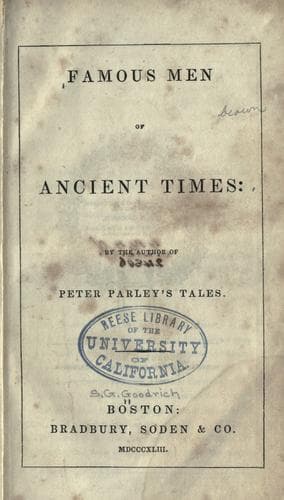
Famous Men of Ancient TimesGoodrich, Samuel G. (Samuel Griswold)
History
Famous Men of Ancient Times
Goodrich, Samuel G. (Samuel Griswold)
Biography -- Juvenile literature; Men -- Biography -- Juvenile literature
Posthumous honors in great variety have been conferred upon Confucius.
Soon after his death, the prince of Lú entitled him _Ní fú_, or father
Ní; which under the reign of Lintí, of the Hán dynasty, 197 B. C., was
changed to _Ní kung_, or duke _Ní_, and his portrait was ordered to be
hung up in the public school. By the emperors of the Tang dynasty it
was made _sien shing_, the ancient sage. He was next styled the royal
preacher, and his effigy clad in king’s robes, and a crown put on
its head. The Ming dynasty called him the most holy ancient teacher,
Kungtsz’, which title is now continued to him. His descendants have
continued to dwell in Shántung province, and the heads of the family
have enjoyed the rank of nobility, being almost the only hereditary
noblemen in the empire out of the imperial kingdom. They are called
Yenshing kung. In the reign of Kánghí, one hundred and twenty years
ago, the descendants of the sage numbered eleven thousand males; the
present is said to be the seventy-fourth generation. The chief of the
family is commonly called the “holy duke,” and enjoys all the honors
of a prince. Whenever he visits the court, the emperor receives him
with almost the same respect and ceremony as he does ambassadors from
foreign countries. P. Amiot relates that he was honored with a call
from him, upon one of his visits to court. “He was a pleasant and
modest man, whom knowledge had not filled with conceit. He received,
when he came to our house, some religious books, which we offered
him in exchange for some Chinese books he gave us. His name was Kung
Chauhán, and he was of the seventy-first generation in direct descent
from the sage,—in all probability the oldest family in the world, of
which the regular descent can be traced.” In the Life of Confucius,
written by Amiot, which forms one of the volumes of the _Mémoires sur
les Chinoises_, there is a brief account of each of these heads of
this family, with notices of other distinguished persons belonging to
the house.
Public-domain text, read in full here on John Shaqi.
Reviews
Reviews
No reviews yet
Be the first to share your thoughts on this work.
Elsewhere in the archive
Join the Discussion
Join the discussion
Sign in to leave a comment or review.
Sign InorCreate an account