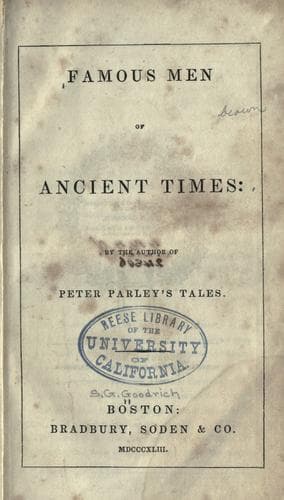
Famous Men of Ancient TimesGoodrich, Samuel G. (Samuel Griswold)
History
Famous Men of Ancient Times
Goodrich, Samuel G. (Samuel Griswold)
Biography -- Juvenile literature; Men -- Biography -- Juvenile literature
ALCIBIADES, 244
DEMOCRITUS, 252
PERICLES, 256
ARISTIDES, 261
ÆSOP, 264
SOLON, 271
LYCURGUS, 277
HOMER, 282
CONFUCIUS, 291
[Illustration]
FAMOUS MEN OF ANCIENT TIMES
[Illustration]
MOHAMMED.
This individual, who has exercised a greater influence upon the
opinions of mankind than any other human being, save, perhaps, the
Chinese philosopher Confucius, was born at Mecca, in Arabia, A. D.
570. He was the only son of Abdallah, of the noble line of Hashem and
tribe of Koreish—descendants of Ishmael the reputed progenitor of the
Arabian race.
The Koreishites were not only a commercial people, and rich by virtue
of their operations in trade, but they were the hereditary guardians
of the Caaba, or Kaaba, a heathen temple at Mecca. The custody of this
sacred place, together with all the priestly offices, belonged to the
ancestors of Mohammed.
The Mohammedan authors have embellished the birth of the prophet with a
great variety of wonderful events, which are said to have attended his
introduction into the world. One of these is, that the Persian sacred
fire, kept in their temples, was at once extinguished over all Arabia,
accompanied by the diffusion of an unwonted and beautiful light. But
this and other marvels, we leave to the credulity of the prophet’s
followers.
Mohammed’s father died early, and his son came under the guardianship
of his uncle, Abu Taleb. He was a rich merchant, who was accustomed
to visit the fairs of Damascus, Bagdad, and Bassora—three great and
splendid cities, and Mohammed often accompanied him to these places.
In his twelfth year, Mohammed took part in an expedition against
the wandering tribes that molested the trading caravans. Thus, by
travelling from place to place, he acquired extensive knowledge, and,
by being engaged in warlike enterprise, his imagination became inflamed
with a love of adventure and military achievements. If we add to
this, that he had naturally a love of solitude, with a constitutional
tendency to religious abstraction; and if, moreover, we consider that
in his childhood he had been accustomed to behold the wild exercises,
the dark ceremonies, and hideous rites of the temple of Caaba—we
shall at once see the elements of character, and the educational
circumstances, which shaped out the extraordinary career of the founder
of Islamism.
Public-domain text, read in full here on John Shaqi.
Reviews
Reviews
No reviews yet
Be the first to share your thoughts on this work.
Join the Discussion
Join the discussion
Sign in to leave a comment or review.
Sign InorCreate an account