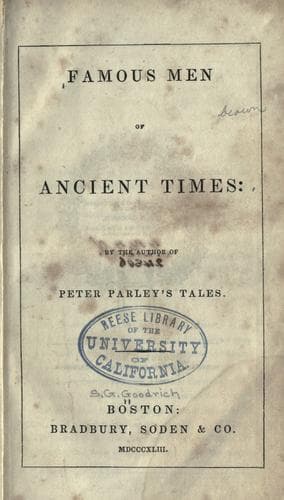
Famous Men of Ancient TimesGoodrich, Samuel G. (Samuel Griswold)
History
Famous Men of Ancient Times
Goodrich, Samuel G. (Samuel Griswold)
Biography -- Juvenile literature; Men -- Biography -- Juvenile literature
This ready obedience dissipated the suspicions of the emperor, and he
made ample and prompt reparation for his unfounded jealousy. Medals
were struck by his orders, bearing on one side the effigy of the
emperor, and on the other that of the victorious general, encircled by
the inscription, _Belisarius, the glory of the Romans_. Beside this,
the honors of a triumph were decreed him, the first ever witnessed in
the Eastern capital.
The ceremony was in the highest degree imposing. The triumphal
procession marched from the house of Belisarius to the hippodrome,[2]
filled with exulting thousands, where Justinian and Theodora sat
enthroned. Among the Vandal captives, Gelimer was distinguished by the
purple of a sovereign. He shed no tears, but frequently repeated the
words of Solomon, “Vanity of vanities: all is vanity.” When he reached
the imperial throne, and was commanded to cast aside the ensigns of
royalty, Belisarius hastened to do the same, to show him that he was to
undergo no insult as a prisoner, but only to yield the customary homage
of a subject. We may pause for a moment to reflect upon the caprices
of fortune, which had raised a comedian, in the person of Theodora, to
see the successor of Genseric and Scipio prostrate as slaves before her
footstool.
Both the conqueror and captive experienced the effects of imperial
generosity. The former received a large share of the spoil as his
reward, and was named consul for the ensuing year. To the Vandal
monarch, an extensive estate in Galatia was assigned, to which he
retired, and, in peaceful obscurity, spent the remainder of his days.
We must now turn our attention to Italy. Theodoric the Great, the
natural son of Theodomir, king of the Ostrogoths, became the master of
Italy toward the close of the fifth century. The Gothic dominion was
thus established in the ancient seat of the Roman empire, and the king
of the Goths was seated upon the throne of the Cæsars.
Theodoric has furnished one of the few instances in which a successful
soldier has abandoned warlike pursuits for the duties of civil
administration, and, instead of seeking power by his arms, has devoted
himself to the improvement of his kingdom by a peaceful policy. Upright
and active in his conduct, he enforced discipline among his soldiers,
and so tempered his general kindness by acts of salutary rigor, that
he was loved as if indulgent, yet obeyed as if severe. He applied
himself to the revival of trade, the support of manufactures, and the
encouragement of agriculture.
At the death of this great monarch, in 526, his grandson, Athalaric,
then only ten years of age, became king. After a nominal reign of eight
years he died in consequence of his dissipations, and was succeeded by
Theodatus, the nephew of Theodoric. This prince having attained the
throne by the murder of Amalasontha, the widow of Theodoric, Justinian
regarded him as an usurper stained with an atrocious crime, and
therefore determined to drive him from his throne.
Public-domain text, read in full here on John Shaqi.
Reviews
Reviews
No reviews yet
Be the first to share your thoughts on this work.
Join the Discussion
Join the discussion
Sign in to leave a comment or review.
Sign InorCreate an account