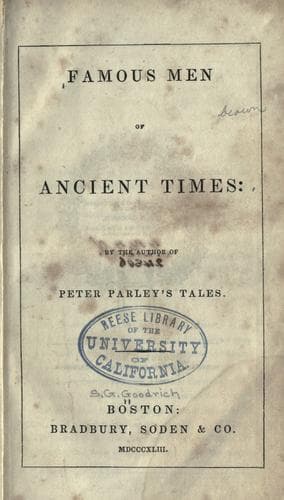
Famous Men of Ancient TimesGoodrich, Samuel G. (Samuel Griswold)
History
Famous Men of Ancient Times
Goodrich, Samuel G. (Samuel Griswold)
Biography -- Juvenile literature; Men -- Biography -- Juvenile literature
Antonina, by her convenient intrigues in behalf of Theodora, had laid
her under great obligations, and obtained the greatest influence
over her. The empress, therefore, now interfered to save her friend.
Positive injunctions were sent to Cilicia, and both Photius and
Theodosius were brought to Constantinople. The former was cast into
a dungeon and tortured at the rack; the latter was received with
distinction; but he soon expired from illness. Photius, after a third
escape from prison, proceeded to Jerusalem, where he took the habit of
a monk, and finally attained the rank of abbot.
Belisarius and Antonina were summoned to Constantinople, and the
empress commanded the injured husband to abstain from the punishment
of his wife. He obeyed this order of his sovereign. She next required
a reconciliation at his hands; but he refused to comply with a demand
which no sovereign had a right to make. He, therefore, remained
at Constantinople, under the secret displeasure of Theodora and
Justinian, who only wanted some plausible pretext to accomplish his
ruin.
The invasion of Nushirvan, in the ensuing spring impelled the
terrified emperor to lay aside his animosity, and restore the hero
to the direction of the eastern armies; but in this campaign, his
former offence was aggravated, and the glory of saving the East was
outweighed by the guilt of frankness. Justinian was recovering from a
dangerous illness; a rumor of his death had reached the Roman camp, and
Belisarius gave an opinion in favor of the emperor’s nearest kinsman
as his successor, instead of acknowledging the pretensions of Theodora
to the throne. This declaration inflamed with equal anger the aspiring
wife and the uxorious husband.
Buzes, the second in command, who had concurred in these views, was
confined in a subterranean dungeon, so dark that the difference of day
and night was never apparent to its inmate. Belisarius himself was
recalled, with flattering professions of confidence and friendship,
lest resentment should urge him to rebellion; but on his arrival at
Constantinople, the mask was thrown aside; he was degraded from the
rank of general of the East; a commission was despatched into Asia to
seize his treasures; and his personal guards, who had followed his
standard through so many battles, were removed from his command.
It was with mingled feelings of compassion and surprise, that the
people beheld the forlorn appearance of the general as he entered
Constantinople, and rode along the streets, with a small and squalid
train. Proceeding to the gates of the palace, he was exposed during
the whole day to the scoffs and insults of the rabble. He was received
by the emperor and Theodora with angry disdain, and when he withdrew,
in the evening, to his lonely palace, he frequently turned round,
expecting to see the appointed assassins advancing upon him.
Public-domain text, read in full here on John Shaqi.
Reviews
Reviews
No reviews yet
Be the first to share your thoughts on this work.
Join the Discussion
Join the discussion
Sign in to leave a comment or review.
Sign InorCreate an account