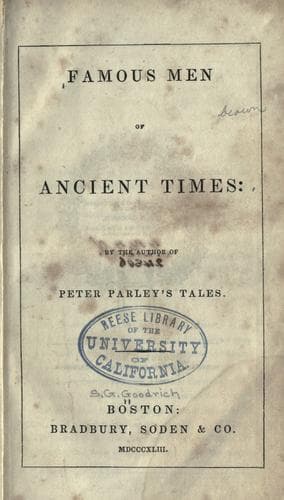
Famous Men of Ancient TimesGoodrich, Samuel G. (Samuel Griswold)
History
Famous Men of Ancient Times
Goodrich, Samuel G. (Samuel Griswold)
Biography -- Juvenile literature; Men -- Biography -- Juvenile literature
It is not surprising that a profession thus practised should be honored
among the Roman people, nor is it wonderful that Cicero’s ambitious
mind should have been attracted by so obvious a road to honor and
preferment. But his views were not satisfied with being a mere lawyer.
He desired especially to be an orator; and, conceiving that all kinds
of knowledge would be useful in such a profession, he sought every
opportunity to increase his stores of information. He also attended
constantly at the forum, to hear the speeches and pleadings; he
perused the best authors with care, so as to form an elegant style;
and cultivated poetry, for the purpose of adding elegance and grace to
his mind. While he was thus engaged, he also studied philosophy, and,
for a time, was greatly pleased with Phædrus, the Epicurean, who then
gave lessons at Rome. Though he retained his affection for the amiable
philosopher, Cicero soon rejected his system as fallacious.
It was always a part of the education of the young gentlemen of Rome,
to learn the art of war by personal service, under some general of
name and experience. Cicero accordingly took the opportunity to make
a campaign with Strabo, the father of Pompey the Great. During this
expedition, he manifested the same diligence in the army that he had
done in the forum, to observe everything that passed. He sought to be
always near the person of the general, that nothing of importance might
escape his notice.
Returning to Rome, Cicero pursued his studies as before, and about
this time, Molo, the Rhodian, one of the most celebrated teachers of
eloquence of that age, coming to the city to deliver lectures upon
oratory, he immediately took the benefit of his instructions, and
pursued his studies with ceaseless ardor. His ambition received an
impulse at this time, from witnessing the fame of Hortensius, who made
the first figure at the bar, and whose praises fired him with such
emulation, that, for a time, he scarcely allowed himself rest from his
studies, either day or night.
He had in his own house a Greek preceptor, who instructed him in
various kinds of learning, but more particularly in logic, to which
he paid strict attention. He, however, never suffered a day to pass,
without some exercise in oratory, particularly that of declaiming,
which he generally performed with some of his fellow-students. He
sometimes spoke in Latin, but more frequently in Greek, because the
latter furnished a greater variety of elegant expressions, and because
the Greek masters were far the best, and could not correct and improve
their pupils, unless they declaimed in that language.
Public-domain text, read in full here on John Shaqi.
Reviews
Reviews
No reviews yet
Be the first to share your thoughts on this work.
Join the Discussion
Join the discussion
Sign in to leave a comment or review.
Sign InorCreate an account