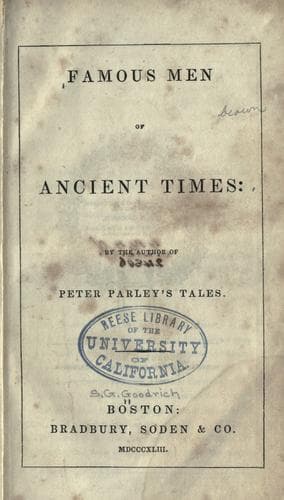
Famous Men of Ancient TimesGoodrich, Samuel G. (Samuel Griswold)
History
Famous Men of Ancient Times
Goodrich, Samuel G. (Samuel Griswold)
Biography -- Juvenile literature; Men -- Biography -- Juvenile literature
The senate now conferred upon him the office of pro-consul, or
governor, of Cilicia, in Asia Minor, whither he immediately proceeded.
He discharged the duties of this office with ability, and, on his
return, was decreed a triumph. But he was prevented from enjoying it
by the factious opposition of his enemies. On his return, he found
Rome agitated with serious disturbances. The rupture between Cæsar and
Pompey had taken place, and the horrors of a civil war seemed to be
impending over the republic. In vain did he attempt to reconcile the
fierce and haughty rivals.
Cæsar advanced upon Rome, and Pompey was forced to fly with the consuls
and the senate. Cæsar had met Cicero at Formiae, and sought to gain
him over to his cause, but though convinced that he would prevail in
the coming struggle, he felt himself prompted, by a sense of honor to
return to Pompey, who had served him so effectually during his exile.
After the fatal battle of Pharsalia and the flight of Pompey, he
returned to Rome, where he was graciously received by Cæsar.
He now devoted himself to literary and philosophical pursuits, and,
soon after, divorced his wife Terentia, an act which has justly
subjected him to much reproach. It is true that she was a woman of
an imperious and turbulent spirit, expensive and negligent in her
private affairs, busy and intriguing in public matters. But these
qualities were in some degree compensated by her devotion to Cicero,
and especially by the energy with which she had sought to effect his
return during his exile. His letters to her at this period recognise
her efforts in his behalf, and are full of the most tender expressions
of affection and esteem.
It must be remarked that the nuptial bond was lightly regarded at this
period in Rome, and divorces were so common as to be little thought
of. Terentia was soon after married to Sallust, the historian, by
which it would seem that her separation from Cicero inflicted upon her
no disgrace. Cicero would perhaps have been little blamed, were it
not that he was soon after married to a young lady named Publilia, of
whom he was guardian, and who had been committed to his care by her
father’s will. She had a large estate, and this was doubtless Cicero’s
inducement to the match, if not to the divorce of Terentia. It is the
suspicion of such motives, in these transactions, that has sullied the
fame of Cicero. We may add here, in respect to Terentia, that she was
once or twice married after the death of Sallust, and lived to the age
of one hundred and three years.
Public-domain text, read in full here on John Shaqi.
Reviews
Reviews
No reviews yet
Be the first to share your thoughts on this work.
Elsewhere in the archive
Join the Discussion
Join the discussion
Sign in to leave a comment or review.
Sign InorCreate an account