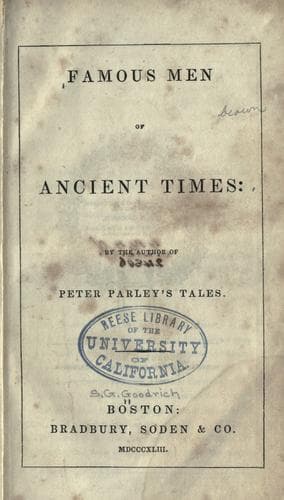
Famous Men of Ancient TimesGoodrich, Samuel G. (Samuel Griswold)
History
Famous Men of Ancient Times
Goodrich, Samuel G. (Samuel Griswold)
Biography -- Juvenile literature; Men -- Biography -- Juvenile literature
Cæsar, having established himself as dictator, Cicero was induced to
assent to his government. Accordingly, he pronounced a famous oration,
in which he mingled as much counsel as panegyric for the despot. He
was rapidly regaining his former consideration, when the conspiracy
of Brutus and his associates terminated the career of the ambitious
usurper. Antony now took Cæsar’s place, and while he was prosecuting
his designs, Cicero returned to his literary occupations. He went to
Greece for a time, but soon returned, and pronounced those famous
orations against Antony, which are called Philippics.
Octavius, known as Augustus Cæsar, and the nephew of Julius Cæsar,
united his interests with those of Antony, and having obtained the
consulate, soon gained an ascendency over the senate. Cicero, in his
retirement at Tusculum, saw that the power having passed into the
hands of desperate men, the liberty of Rome was no more. He soon heard
that his own name was included among those of the proscribed. He fled
immediately to Astura, on the sea coast, where he found a vessel
waiting for him.
He here embarked, but contrary winds drove him back to the shore. At
the earnest entreaty of his slaves, he embarked a second time, but
returned to await his fate at his country seat near Formiae, declaring,
“I will die in my country, which I have more than once saved.” His
slaves, seeing the neighborhood already disturbed by the soldiers of
Antony, endeavored to convey him away in a litter, but soon discovered
the assassins, who had been sent to take his life, at their heels.
They prepared for resistance, but Cicero, who felt that death was
unavoidable, bowed his head before Pompilius, the commander of the
murderers, who had once been saved by his eloquence, and suffered death
more courageously than he had borne misfortune.
Thus died Cicero, and with him the liberties of Rome. The dynasty of
the emperors was built upon the ruins of the republic, and, continuing
for five centuries, was finally extinguished in the gloom of the dark
ages. Cicero was killed on the 7th December, 43 B. C., at the age of
sixty-three. His head and hands were severed from the body, by his
murderers, and carried to Antony, who caused the former to be placed
upon the rostra in the forum, between the two hands. The odium of these
barbarities fell chiefly upon Antony, yet they left a stain of perfidy
and ingratitude upon Augustus, which can never be wiped away.
Public-domain text, read in full here on John Shaqi.
Reviews
Reviews
No reviews yet
Be the first to share your thoughts on this work.
Elsewhere in the archive
Join the Discussion
Join the discussion
Sign in to leave a comment or review.
Sign InorCreate an account