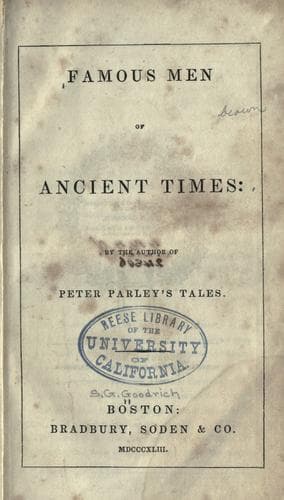
Famous Men of Ancient TimesGoodrich, Samuel G. (Samuel Griswold)
History
Famous Men of Ancient Times
Goodrich, Samuel G. (Samuel Griswold)
Biography -- Juvenile literature; Men -- Biography -- Juvenile literature
In his person, Cicero was tall and slender, yet his features were
regular and manly. He mingled great dignity with an air of cheerfulness
and serenity, that inspired both affection and respect. His
constitution was naturally weak, but his prudent habits enabled him to
support all the fatigues of an active and studious life, with health
and vigor. In dress, he avoided singularity, and was only remarkable
for personal neatness and appropriateness of attire. In domestic
and social life, his demeanor was exceedingly amiable. He was an
affectionate parent, a zealous friend, a generous master. Yet he was
not more generous to his friends than placable to his enemies. It was
one of his sayings, delivered in a public assembly, that “his enmities
were mortal, his friendships immortal.”
The moral character of Cicero was not blemished by the stain of any
habitual vice. He was, indeed, the shining pattern of virtue in an age,
of all others, the most licentious and profligate. His great soul was
superior to the sordid passions which engross little minds—avarice,
envy and malice. His familiar letters, in which he pours out his whole
heart, are free from anything base, immodest or vengeful. A uniform
principle of benevolence, justice, love of his friends and his country,
is seen to flow through the whole, inspiring all his thoughts and words
and actions.
The failings of Cicero consisted chiefly in his vanity and that
despondency under adverse circumstances, which seemed unworthy of his
character. With these abatements, we must pronounce him a truly great
and good man—the glory of Rome, an honor to human nature. His works,
a large portion of which are extant, are among the richest treasures
bequeathed to us by antiquity, and there are few minds so exalted, even
with the advantages of our own time, as not to find instruction in his
pages.
[Illustration]
CAIUS JULIUS CÆSAR.
This celebrated Roman, famous for his intrigues, his generalship, his
eloquence and his talents, was born in the year 100 B. C. He was of a
good family, and his aunt Julia was wife of Caius Marius, who had been
consul. We know little of him in his youth, though it would seem that
he early attracted attention by his abilities and ambition. At the age
of fifteen, he left his father, and was made a priest in the temple of
Jupiter, the year after. At the age of seventeen, he married Cornelia,
a daughter of Cinna. By this marriage, and through his aunt Julia, he
was allied both to Marius and Cinna, the two principal opposers of
Sylla, who had acquired an ascendency in Rome, and exercised his power
with fearful and bloody tyranny. Soon after his marriage, Cæsar became
an object of suspicion to the despot; he was stripped of his office
as priest of Jupiter, his wife’s dower was confiscated, and he, being
threatened with death, deemed it prudent to seek safety in flight.
Public-domain text, read in full here on John Shaqi.
Reviews
Reviews
No reviews yet
Be the first to share your thoughts on this work.
Elsewhere in the archive
Join the Discussion
Join the discussion
Sign in to leave a comment or review.
Sign InorCreate an account