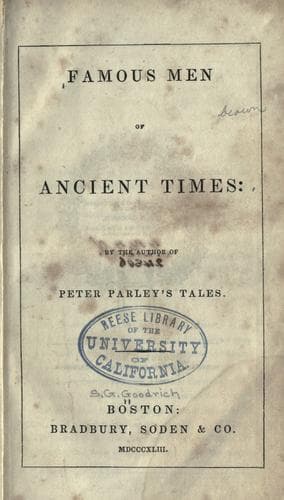
Famous Men of Ancient TimesGoodrich, Samuel G. (Samuel Griswold)
History
Famous Men of Ancient Times
Goodrich, Samuel G. (Samuel Griswold)
Biography -- Juvenile literature; Men -- Biography -- Juvenile literature
Rome was at this time a republic, in which there was a constant
struggle for ascendency between the aristocracy and the
democracy—between the privileged few and the people. Sylla had placed
the former on a firm footing; for a time, therefore, Cæsar, who
courted the people, took no open part, but looked calmly on, waiting
and watching for his opportunity. He, however, seized every occasion
to please and flatter the people; he gave expensive entertainments to
which they were invited; he attached to his person the talented and
enterprising young men; he distributed presents, paid compliments, and
said a thousand pleasant things, calculated to flatter those whose
favor he desired. He also made public speeches on various occasions,
in all of which he avowed sentiments which gratified the plebeians.
Thus beginning afar off and steadily approaching his object he was ere
long in a situation to realize it. Cato, who had watched him carefully,
discovered his dangerous ambition, but he could not prevent the success
of his schemes.
At the age of thirty-one, he was chosen by the people, as one of the
military tribunes, an office which gave him the command of a legion, or
division in the army. The year following, he was quæstor, or receiver
of public moneys in Spain; and in the year 68, having returned to Rome,
he was chosen edile—an office which gave him charge of the public
buildings.
In this situation, he had an opportunity to indulge his taste for
magnificence and display; at the same time, he gratified the people. He
beautified the city with public edifices and gave splendid exhibitions
of wild beasts and gladiators.
He was now thirty-five years old, and being desirous of military glory,
he sought a command in Egypt. He offered himself as a candidate—but
failed. The next year he took his measures more carefully. The
corruption of the voters of Rome, at that time, was such as to excite
our disgust. On the day of election, there were stalls, openly kept,
where the votes of the freemen were bought, with as little shame, as if
they had been common merchandise. We hardly know which most to despise,
the crafty leaders, who thus corrupted the people, or the venal voters,
who abused and degraded the dearest of privileges.
Public-domain text, read in full here on John Shaqi.
Reviews
Reviews
No reviews yet
Be the first to share your thoughts on this work.
Elsewhere in the archive
Join the Discussion
Join the discussion
Sign in to leave a comment or review.
Sign InorCreate an account