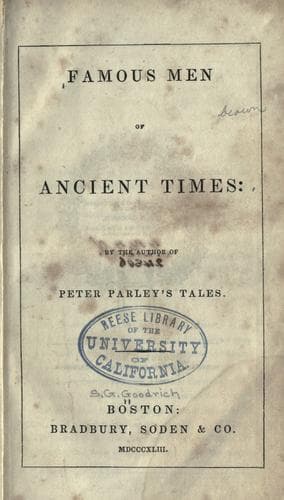
Famous Men of Ancient TimesGoodrich, Samuel G. (Samuel Griswold)
History
Famous Men of Ancient Times
Goodrich, Samuel G. (Samuel Griswold)
Biography -- Juvenile literature; Men -- Biography -- Juvenile literature
Though Cæsar was from the beginning a professed champion of the
democracy, yet the manner in which he treated those whose support he
sought, showed that his designs were selfish; that he wished to make
the people instruments of his ambition. A man who will flatter the
mass; use false, yet captivating arguments with them; appeal to their
prejudices; fall in with their currents of feeling and opinion, even
though they may be wrong, may profess democracy but he is at heart an
aristocrat: he has no true love for the people; no confidence in them;
he really despises them, and looks upon them but as the despicable
tools of his ambition. Such was Cæsar, and such is always the popular
demagogue. While nothing is more noble than a true democrat—a true
well-wisher of the people—and one who honestly seeks to vindicate
their rights, enlighten their minds, and elevate them in the scale of
society; so nothing is more base than a selfish desire to govern them,
hidden beneath the cloak of pretended democracy.
The measures of Cæsar were now so open, and his real character so
obvious, that we should wonder at his success with the people, did we
not know the power which flattery exerts over all mankind, and that
when a man of rank and talents becomes a demagogue, he is usually more
successful than other men. It was so, at least, with Cæsar. He courted
the populace on all occasions; he distributed money with a lavish hand,
particularly among the poorer voters.
After many intrigues, he obtained the office of prætor, at the end
of a sharply contested election. This office was one of high dignity
and trust. The prætor administered justice, protected the rights of
widows and orphans—presided at public festivals was president of the
senate, in the absence of the consul, and assembled or prorogued the
senate at his pleasure. He also exhibited shows to the people, and in
the festivals of Bona Dea, where none but women were admitted, his wife
presided.
In obtaining this office, Cæsar achieved a great triumph. He also
increased his power, and reached a situation which enabled him still
more to flatter the people. An event, however, occurred about this
time, which gave him great annoyance. During the ceremonies in honor
of the Bona Dea, at his house, a profligate person, named Clodius,
disguised as a woman, gained access to the festivities. This caused a
great deal of scandal, and Cæsar divorced his wife, Pompeia, whom he
had married after the death of Cornelia.
Public-domain text, read in full here on John Shaqi.
Reviews
Reviews
No reviews yet
Be the first to share your thoughts on this work.
Elsewhere in the archive
Join the Discussion
Join the discussion
Sign in to leave a comment or review.
Sign InorCreate an account