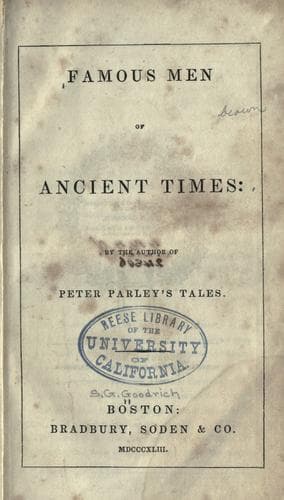
Famous Men of Ancient TimesGoodrich, Samuel G. (Samuel Griswold)
History
Famous Men of Ancient Times
Goodrich, Samuel G. (Samuel Griswold)
Biography -- Juvenile literature; Men -- Biography -- Juvenile literature
Scipio, having finished the war in Spain, now transported his army
across the Mediterranean: thus _carrying the war into Africa_, and
giving rise to an expression still in vogue, and significant of
effective retaliation. By the aid of Massinissa, a powerful prince of
Numidia, now Morocco, he gained two victories over the Carthaginians,
who were obliged hastily to recall their great commander from Italy.
He landed at Leptis, and advanced near Zama, five days’ journey to
the west of Carthage. Here he met the Roman forces, and here, for the
first time, he suffered a total defeat. The loss of the Carthaginians
was immense, and they were obliged to sue for peace. This was granted
on humiliating terms by Scipio, called Africanus, after this victory.
Hannibal would still have resisted, but he was compelled by his
countrymen to submit. Thus ended the second Punic war, 200 B. C, having
continued about eighteen years.
Hannibal now applied himself to the reform of abuses in the government
of Carthage. In this he was supported by the people, but he incurred
the dislike of certain leading men among his countrymen. These,
insensible to his great services, and only guided by their jealousy,
sent to the Roman authorities certain representations, calculated to
excite their suspicion and arouse their anger against him. Ambassadors
were accordingly sent to Carthage, to demand his punishment; but
Hannibal, foreseeing the storm, fled to Tyre. From this place he went
to Ephesus, and induced Antiochus to declare war against Rome, B. C.
196. He had himself but a subordinate command, and when the war, which
proved unfortunate, was over, he was compelled to depart, and seek a
refuge with Prusias, prince of Bithynia, in Asia Minor. The Romans,
being uneasy so long as their formidable enemy was alive, sent to
Prusias to demand that he should be given up. Hannibal, now driven to
extremity, and sick of life, destroyed himself by poison, B. C. 183, in
the sixty-fifth year of his age.
Public-domain text, read in full here on John Shaqi.
Reviews
Reviews
No reviews yet
Be the first to share your thoughts on this work.
Elsewhere in the archive
Join the Discussion
Join the discussion
Sign in to leave a comment or review.
Sign InorCreate an account