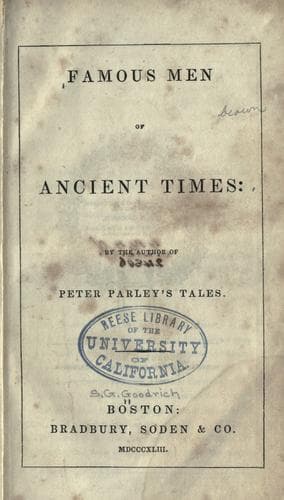
Famous Men of Ancient TimesGoodrich, Samuel G. (Samuel Griswold)
History
Famous Men of Ancient Times
Goodrich, Samuel G. (Samuel Griswold)
Biography -- Juvenile literature; Men -- Biography -- Juvenile literature
We have no accounts of this wonderful man except from his enemies, the
Romans, and nothing from them but his public career. Prejudiced as are
these sources of evidence, they still exhibit him as one of the most
extraordinary men that has ever lived. Many of the events of his life
remind us of the career of Napoleon. Like him, he crossed the Alps with
a great army; like him, he was repeatedly victorious over disciplined
and powerful forces in Italy; like him, he was finally overwhelmed in a
great battle; like him, he was a statesman as well as a general; like
him, he was the idol of the army; like him, he was finally driven from
his country and died in exile. No one achievement of Bonaparte’s life
was equal to that of Hannibal in crossing the Alps, if we consider
the difficulties he had to encounter; nor has anything in generalship
surpassed the ability he displayed in sustaining himself and his army,
for sixteen years, in Italy, in the face of Rome, and without asking
for assistance from his own country.
During this whole period he never once dismissed his forces, and
though they were composed of Africans, Spaniards, Gauls, Carthaginians
and Greeks—persons of different laws, languages and habits—never
was anything like mutiny displayed among them. How wonderful was the
genius that held such a vast number of persons—the fiery spirits of
so many different nations—subject to one will, and obedient to one
authority! Where can we look for evidence of talent superior to this?
We cannot doubt that Hannibal, in addition to his great mind, possessed
those personal qualifications, which enabled him to exercise powers
of fascination over all those persons who came into his presence; and
that, in this respect too, he bore a resemblance to Napoleon.
We may not approve, yet we can hardly fail to admire, the unflinching
hostility of Hannibal to Rome. He had been taught this in his
childhood; it came with the first lessons of life, and from the lips
of a father; he had sworn it at the altar. Rome was the great enemy
of his country; and as he loved the last, he must hate the first. His
duty, his destiny, might serve to impel him to wage uncompromising war
against Rome; for this he lived—for this, at last, he died.
Nor can we believe that this sentiment, which formed the chief spring
of his actions, was unmixed with patriotism. Indeed, this was
doubtless at its very root. It was for the eclipse that she cast over
Carthage, that he would annihilate Rome. It was from a conviction
that one of these great powers must give way to the other—that
the existence of Rome boded destruction to Carthage—that he waged
uncompromising and deadly war upon the former.
Public-domain text, read in full here on John Shaqi.
Reviews
Reviews
No reviews yet
Be the first to share your thoughts on this work.
Elsewhere in the archive
Join the Discussion
Join the discussion
Sign in to leave a comment or review.
Sign InorCreate an account