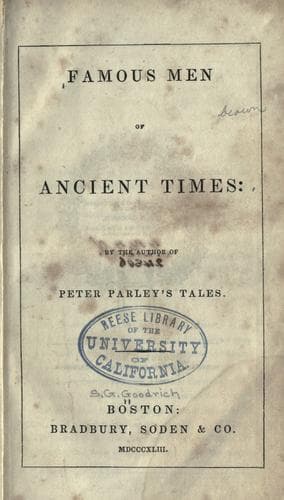
Famous Men of Ancient TimesGoodrich, Samuel G. (Samuel Griswold)
History
Famous Men of Ancient Times
Goodrich, Samuel G. (Samuel Griswold)
Biography -- Juvenile literature; Men -- Biography -- Juvenile literature
It is interesting to remark here, that both Philip and Alexander,
powerful sovereigns and men of great minds, were yet inferior, in what
constitutes greatness, to Aristotle. They treated him, indeed, as their
inferior—an object of their patronage; and it is also true, that
both Philip and Alexander are remembered at the present day; but the
consequences of their actions ceased ages ago. Not so with Aristotle:
his books being preserved, have come down to our times, and for two
thousand years have been constantly exercising a powerful influence
over mankind. There can be no doubt, therefore, that the schoolmaster
is infinitely above the prince; the one lives for a generation, the
other for all time; the one deals with external things which perish;
the other with knowledge, science—principles—which never die. The one
is a being of action, the other of mind; the one may be great for a
brief space in the eye of vulgar observation, but he is soon quenched
in utter oblivion; the other, though his body be dead, still lives by
the power of the spirit. It is desirable to impress this truth on our
hearts, for it shows that true glory lies in cultivating and exercising
the mind; while, in comparison, it is a poor and mean ambition, which
incites us to seek only worldly power or wealth or station.
At an early period, Alexander displayed noble qualities, amid some
vices. He was exceedingly ambitious, and when news came that his father
had taken some strong town, or won some great battle, “My father will
conquer,” he exclaimed impatiently “the whole world, and will leave
nothing for me to conquer.” Though in the light of our Christian
philosophy, nothing more wicked than the feelings here displayed could
exist, still it accorded with the education he had received, and was
an earnest of that love of war and conquest which signalized his after
career. It may be stated, also, that Alexander did not value riches
or pleasure, in his youth, but seemed to be always excited by a love
of glory; he did not desire a kingdom that should afford him opulence
and the means of luxury, but one that would bring wars and conflicts,
and the full exercise of ambition. A sad portrait this, viewed in the
light of our day—yet the very description of a hero, and almost of a
god, in the age and country in which he lived.
Public-domain text, read in full here on John Shaqi.
Reviews
Reviews
No reviews yet
Be the first to share your thoughts on this work.
Elsewhere in the archive
Join the Discussion
Join the discussion
Sign in to leave a comment or review.
Sign InorCreate an account