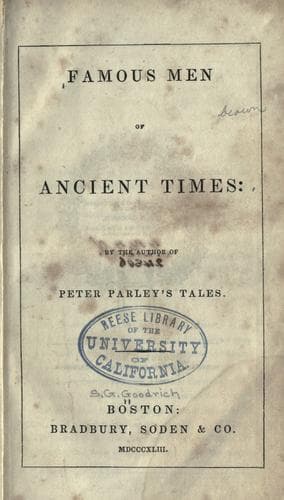
Famous Men of Ancient TimesGoodrich, Samuel G. (Samuel Griswold)
History
Famous Men of Ancient Times
Goodrich, Samuel G. (Samuel Griswold)
Biography -- Juvenile literature; Men -- Biography -- Juvenile literature
Some time after Arcadius’ departure from Macedon, word was brought
that the king’s old enemy had become one of his warmest friends, and
did nothing but diffuse his praises wherever he went. On hearing this,
Philip turned to his courtiers, and said with a smile, “Am not I a
better physician than you are?” We are also told of numerous instances
in which Philip treated his prisoners of war with a kindness quite
unusual in the barbarous age in which he lived. Though dissolute in
private life, as a prince he was far in advance of his nation in all
that belongs to civilization.
No better evidence of his enlightened views can be required than is
afforded by the pains he bestowed upon the education of Alexander,
his eldest son, and heir to his throne. He obtained for him the best
masters, and finally placed him under the care of Aristotle, then the
most learned and famous philosopher of Greece, and one of the most
extraordinary men that ever lived. It cannot but be interesting and
instructive to trace the history of the greatest warrior, who was, at
the same time, the pupil of the greatest philosopher, of antiquity.
Alexander was an apt and attentive student, and easily mastered the
studies to which he applied. He was somewhat headstrong if treated
with harshness, and he resisted, if an attempt was made to drive him.
He, however, was docile and obedient when treated gently. It would
seem, that, in this at least, he was very much like the clever boys
of our own day. He mastered not only matters of science, but polite
literature also. He was greatly delighted with Homer’s Iliad, and, it
is thought, modelled himself upon the warlike heroes of that poem. In
after days, even in his campaigns, he took a copy of this work with
him, and in the camp, read it at moments of leisure, and slept with it
at night beneath his pillow.
Alexander was greatly attached to Aristotle during his pupilage,
though he changed both in feeling and conduct towards him afterwards.
Philip seems to have formed a high estimate of the services rendered
by Aristotle. The latter being born at Stagira—and hence called the
Stagirite—which had been dismantled, Philip ordered it, in compliment
to the philosopher, to be rebuilt, and re-established there the
inhabitants which had either fled or been reduced to slavery. He also
ordered a beautiful promenade, called Mirza, to be prepared on the
borders of the river, for the studies and literary conversation of the
people. Here were shown, even in the time of Plutarch, Aristotle’s
stone seats and shady walks.
Public-domain text, read in full here on John Shaqi.
Reviews
Reviews
No reviews yet
Be the first to share your thoughts on this work.
Elsewhere in the archive
Join the Discussion
Join the discussion
Sign in to leave a comment or review.
Sign InorCreate an account