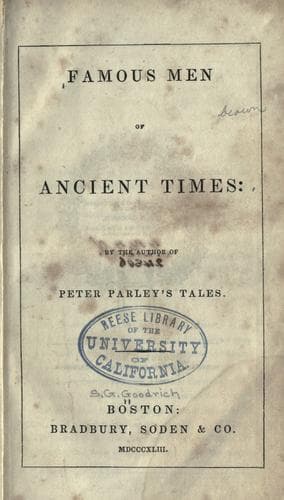
Famous Men of Ancient TimesGoodrich, Samuel G. (Samuel Griswold)
History
Famous Men of Ancient Times
Goodrich, Samuel G. (Samuel Griswold)
Biography -- Juvenile literature; Men -- Biography -- Juvenile literature
Meantime, the Persian generals had pushed forward and posted themselves
upon the banks of the Granicus, a small river now called Ousvola, which
empties into the sea of Marmora. Alexander led the attack upon them
by plunging into the river with his horse. He advanced, with thirteen
of his troop, in the face of a cloud of arrows; and though swept down
by the rapidity of the current, and opposed by steep banks lined with
cavalry, he forced his way, by irresistible strength and impetuosity,
across the stream. Standing upon the muddy slope, his troops were now
obliged to sustain a furious attack, hand to hand, and eye to eye.
The Persian troops, cheered by their vantage ground, pushed on with
terrific shouts, and hurled their javelins, like snow-flakes, upon the
Macedonians. Alexander, being himself distinguished by his buckler and
crest, decorated with white plumes, was the special object of attack.
His cuirass was pierced by a javelin, at the joint; but thus far he was
unhurt. Now he was assailed by two chiefs of great distinction. Evading
one, he engaged the other; after a desperate struggle, in which his
crest was shorn away, and his helmet cleft to his hair, he slew one of
the chiefs, and was saved, at the moment of deadly peril, by the hand
of his friend Clytus, who despatched the other.
While Alexander’s cavalry were fighting with the utmost fury, the
Macedonian phalanx and the infantry crossed the river, and now engaged
the enemy. The effect of a leader’s example was never more displayed.
Alexander’s exhibition of courage and prowess, made every soldier a
hero. They fought, indeed, like persons who knew nothing, and cared
for nothing, but to destroy the enemy. Some of the Persians gave way
and fled. Their hireling Greeks, however, maintained the fight, and
Alexander’s horse was killed under him—but not Bucephalus. “When Greek
meets Greek, then comes the tug of war.” The fight was, indeed, severe,
but at last Alexander triumphed. The victory was complete. The loss of
the Persians was twenty-five thousand slain; that of the Macedonians
less than fifty.
Alexander had now passed the gates of Asia, and had obtained entrance
into the dominions of the enemy. He paused for a time to pay the last
honors to the dead. To each, he erected a statue of brass, executed
by Lysippus. Upon the arms which were taken and distributed among the
troops, he caused this inscription to be made:—“Won by Alexander, of
the barbarians in Asia!”
We may pause here to note that Bonaparte seems to have imitated the
Macedonian conqueror in this kind of boasting. As he was on his march
to Russia, he caused to be graven on a stone fountain at Coblentz upon
the Rhine, as follows:
“Year MDCCCXII. _Memorable for the campaign against Russia._ 1812.”
The Russian commander, when Napoleon had been dethroned, passing
through Coblentz with his troops, caused to be carved, immediately
beneath as follows:
Public-domain text, read in full here on John Shaqi.
Reviews
Reviews
No reviews yet
Be the first to share your thoughts on this work.
Elsewhere in the archive
Join the Discussion
Join the discussion
Sign in to leave a comment or review.
Sign InorCreate an account